The shifting sands of insect protein research
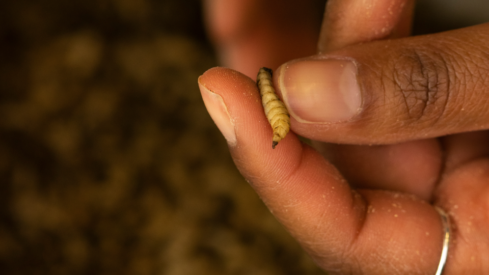
A decade of studies has broadened the scientific assessment of insect inclusion in pet food from protein quality and digestibility to safety, palatability and potential health benefits.
Over the past 12 years, scientific evidence on insects in animal nutrition has expanded considerably. PETS International analyzes the development of the research landscape and how interest has followed the industry’s growing adoption of this category of ingredients.
Diving into the research
The mid-2010s witnessed the first introductions of black solder fly larvae (BSFL) and mealworm into pet food in Europe by Dutch companies Jonker (2014) and Trovet (2015) and German brand Josera (2016). This was followed by significant investment in the launch of BSFL-focused pet food brand Yora in the UK in 2020.
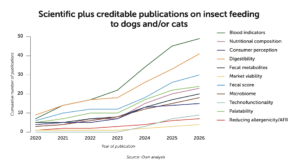
To track the developing research over the past 12 years, a search was conducted in Google Scholar using a combination of pet-related terms – including ‘pet’, ‘pets’, ‘cats’, ‘dogs’, ‘feline’ and ‘canine’ – together with terms related to insects and insect species, such as ‘insect’, ‘BSF’, ‘BSFL’, ‘mealworm’, ‘cricket’, ‘grasshopper’ and ‘silkworm’. Scientific and creditable publications were then assessed for relevance and manually included or excluded from the analysis.
Adjustments in focus
It is clear from the number of published papers that emphasis in early work included less common species such as silkworms and grasshoppers, then shifted to more focused work on BSFL, reflecting the direction of travel by the industry to incorporate this protein source into commercial pet foods.
Interestingly, a similar search for patents related to insects as ingredients between 2014 and 2026 shows a move from protecting cultivation methods through to pet food formulations with specific technical and biological claims, while more recent patent applications consider downstream processing and functional assertions.
Nearly half of the patents are for cultivation methods and around a third are for insect-based formulations for pets.
The rise of BSFL
Early on, science was well on its way to investigating the sustainability credentials of insect over traditional agricultural proteins and, while carbon footprint, water usage, land use and the cost of rearing were affected by insect species and their feed substrate, it was suggested that insect protein had clear advantages over more traditional protein sources.
Although the focus now within the industry is mainly on BSFL, a wide variety of insects have been assessed for their utility in pet foods.
Decisions to progress with these potential insect sources were driven by the efficiency of substrate conversion, feasibility of scaling and pet owner perception, which all impacted on rearing costs and commercial viability. As a result of an advantageous feed conversion rate and an economically viable inclusion rate into food, investment was made in BSFL and mealworm cultivation.
The short life span and lack of a mouth in adult black soldier fly means they are unable to bite, feed or spread disease and were therefore considered a low risk for neighborhood infestations and adverse health effects in the event of accidental escapes from any facilities.
The ability of BSFL to neutralize some pathogenic bacteria and the presence of bioactive components with health benefits in silkworms provided additional rationale for their use. It was from this point that research on the use of insects in pet food took flight.
Nutritional suitability
Insects were deemed useful as replacement protein sources due to their appropriate crude protein levels (somewhere between poultry and egg meal), a high amino acid profile and the presence of chitin, with potentially positive and negative implications for pets.
The nutritional composition depends on insect species, its development stage and feed substrate as well as time of harvest and rearing conditions.
Using DIAAS-like scores to assess protein quality, research from the University of Illinois Urbana- Champaign, published in Journal of Animal Science in 2024, showed the limiting amino acids in BSFL as methionine and cysteine in puppies, adult dogs and kittens, and phenylalanine and tyrosine in adult cats, while methionine, phenylalanine and threonine are the first limiting amino acids in mealworm for cats.
This is reflected in canine diets containing mealworm where crude protein levels are maintained and unsaturated fat content is improved but with a concomitant minor drop in lysine and methionine content, as shown by research from a team at the University of Warmia and Mazury, Poland, published in Animals in 2025.
Reflecting the increased inclusion of insect meals in pet food, scientific publications shifted from early work on the nutritional composition of the ingredients to their impact on marketed finished products. Concerns over higher levels of fiber, attributed to the presence of chitin, and lower than expected mineral values were noted and should be addressed by the industry through targeted studies.
Comparing digestibility
It’s essential that any pet food ingredient can be digested and utilized by the animal. Early work focused on in vitro studies for a range of insects including housefly pupae, house cricket, mealworm species, morio worm, black soldier fly and multiple cockroach species.
Black soldier fly, housefly and yellow mealworm showed high digestibility of amino acids in vitro, with partial fermentation of undigested fractions, as reported in 2016 in Animal Feed Science and Technology by a research team from the Netherlands.
In wet and dry feeds, mealworm appears to be more digestible than BSFL, although dry diets with BSFL showed a higher essential amino acid index and biological value as an indicator of protein quality despite their lower digestibility.
Lower protein digestibility scores and higher fat digestibility have been noted in cats fed diets containing BSFL. This can be partially rectified by reducing the inclusion level, which improved protein digestibility in cats and kittens.
Palatability vs digestibility
In contrast, BSFL meal is well digested by dogs, even at inclusion levels up to 20%. However, reduced apparent digestibility in dogs and cats for dry matter, organic matter, crude protein and fiber in high inclusion BSFL and cricket diets have been attributed to increased chitin levels.
Good digestibility of BSFL oil has been noted when added to diets at up to 8%, even though it can affect palatability. Inclusion level is not always a good indicator of digestibility – no differences in digestibility scores were noted in dogs and cats fed speckled cockroach, Madagascar hissing cockroach and superworm larvae at 7.5% and 15%, as noted by studies published in Journal of Animal Science in 2018 by the Federal University of Lavras (dogs) and in 2022 by the University of Illinois (cats).
Equally important from a nutritional perspective is the palatability of an ingredient – if the best ingredient in the world is unpalatable, then it is effectively useless unless efforts are made to mask the taste.
Initial work noted decreased feed intake in cats given diets containing BSFL, although later studies demonstrated acceptance of BSFL at incremental levels even up to the complete replacement of traditional animal protein.
Safety and validation
Low inclusion levels of BSFL compared against an entirely poultry-based diet improved palatability and digestibility in cats at 3%, and in dogs at 5%, 10% and 15%. Interestingly, one sniff test showed that male dogs preferred mealworm while females preferred Turkestan cockroach.
Of critical importance is to ensure any new ingredient is safe for use at the intended inclusion level in the target animal. Numerous studies have consistently shown that insects are safe for use, although these have sometimes been completed in a small cohort of animals for a short duration.
As a result, more studies are needed for true validation, ideally using more animals over a longer period of time. Changes in inflammatory blood markers or fecal quality are generally limited, suggesting that insects do not impact unduly on these important health parameters and can be regarded as a safe ingredient at the right inclusion level.
Considerations for the future
Clearly, much work has been done on assessing nutritional suitability, as well as the biological and technical functionality of insects as pet food ingredients. However, further study is needed to determine the underlying mechanisms for some of the observed benefits.
As new insects are considered as ingredients, there will be a need to conduct safety, digestibility and palatability studies, as well as leveraging the additional health and technical benefits likely to be found in insects as an ingredient for now and into the future. Geographical, condition, age and breed specific claims will also need to be considered for each new insect tested.
Share this story:
One click prioritizes GlobalPETS in your search results and AI answers.