AI won’t fix your pet food manufacturing. Closing the gap will
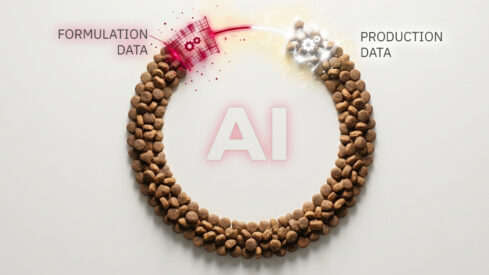
Pet food plants have never had more data, better models or clearer forecasts. One gap swallows the benefit of all three.
Every conference has an AI session now. Every software provider has an AI roadmap. And sooner or later, every pet food manufacturer gets asked the same question: “What’s your AI strategy?”
That question misses the point. Artificial intelligence isn’t a business objective. Manufacturers invest in it because they want to reduce formulation costs, improve production consistency and protect margins. AI only matters if it actually moves those numbers.
The limits of prediction
Most of today’s AI conversation focuses on prediction: finished moisture, ingredient behavior and process deviations. That can be useful, but it is not the whole story. A forecast only creates value when it changes a decision.
Here’s what that looks like in practice. A formula is approved with a moisture target that made sense on paper, based on average ingredient composition. One week later, a new lot of the same raw material comes in slightly wetter than the one it replaced, but the change is not flagged at the formulation level and the recipe remains the same. The batch runs, the finished product comes out a touch off spec, and quality logs it as a deviation. The formulator finds out weeks later, if at all, usually once the pattern has already repeated a few times.
Nothing here was a mistake; it is simply what happens when a formulation is set once, upstream and never hears back from the line that ran it.
The trouble is that most of that knowledge does not go anywhere. Production data stays in production systems, lab results stay in quality reports, and the next formulation gets built on the same assumptions as the last one, instead of on what the line just proved.
So, scientists do the safe thing. They pad the recipe with extra safety margin, plan for a bit of rework and treat variability as the cost of doing business. It works, but it is also expensive, and it happens again on every run, including the one that could have used what the previous run already learned.
Closing the gap, not just measuring it
The real opportunity isn’t another dashboard, or another AI model bolted onto the same disconnected systems. It’s getting formulation, production, and quality to inform each other continuously. If that moisture reading had fed back into the next formulation decision instead of stopping at a quality report, the next batch would have started closer to target, not further from it.
This doesn’t replace formulators, production managers, or quality teams. If anything, it gives them something better to work with: evidence from their own production instead of assumptions made on a spreadsheet, and patterns across thousands of runs that would otherwise stay hidden.
It also has to be specific to actually work. Raw materials differ by supplier, and lines behave differently from one another, even within the same plant. A model trained on generic manufacturing data cannot reflect any one operation’s reality. Only a model built on a manufacturer’s own production history can do that, especially when it is connected to formulation software.
Where the value shows up
Done well, this shows up as lower formulation costs, less raw material giveaway, more consistent finished moisture and safety margins that reflect real variability instead of worst-case guessing. Not because AI adds another layer of technology, but because it closes a gap that has been quietly costing manufacturers money for years, often without being tracked as a single line item.
The manufacturers who get the most out of AI over the next few years will not be the ones running the most tools or simply following the latest technologies. They will be the ones using each production run to improve the next, so that the formula and the line no longer sit on opposite sides of the gap.
See how that works in practice: Close the gap between your formula and your line
Share this story:
One click prioritizes GlobalPETS in your search results and AI answers.