Data: Pet food toppers are gaining popularity, especially among picky eaters
Although some owners remain hesitant due to lack of knowledge, 87% say they’d buy a topper with health benefits.
Food toppers are used by 48% of pet owners, according to a survey conducted by Loops – the data platform by Yummypets – of 2,486 pet parents in the US, Canada, Mexico, Brazil, the UK and France in July 2025.
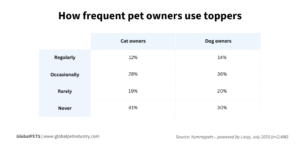
Use is more widespread among dog owners: 14% report giving food toppers regularly, and 36% report doing so occasionally. This represents 50% of dog owners who use toppers.
The overall percentage among cat owners is 40%, with most (28%) giving them occasionally.
In both groups, the proportion of respondents saying “rarely” was similar: about one-fifth.
The Loop survey also shows that 48% of pets given toppers are picky eaters, a percentage higher than that observed in the general population. When we include the pets who don’t receive toppers, the percentage of picky eaters falls to 43%.
The preferences
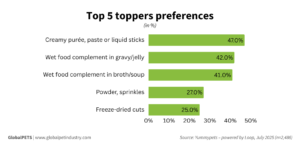
Cats and picky eaters share a common trait: they tend to prefer creamy purées or paste/liquid sticks – or, at least, owners report offering these formats more frequently.
Wet toppers are most popular among both cat and dog owners, whether as a complementary snack in gravy and jelly (42%) or in broth or soup (41%).
Then, come the powder and sprinkle formats (27%), freeze-dried cuts (25%) and flakes (20%).
There are differences across regions. In both Latin America and Europe, creamy purée, paste, or liquid sticks are the most common, although with a different intensity: 59% in Latin America and 40% in Europe. In North America, wet formats are the most commonly used (55%).
Pushes and barriers
Among the 1,123 pet owners who use toppers, some use them first to add nutrients to their pets’ diets (50%), then to provide enrichment and support mental well-being (44%) or to add variety to their pet’s feeding routine (35%).
There are also those who use them to encourage their picky pets to eat (28%), to help their dental health (25%) or to support a specific health concern (21%).
And among the 1,363 owners who don’t use them (or rarely do so), 40% say they didn’t know such products existed, 31% prefer to stick to their pet’s regular food and 20% think it’s too expensive.
Product knowledge
Owners who are unaware of toppers are more common in Latin America (55%), whereas reluctance to change pets’ regular food is more common in North America (38%). In Europe, owners are more divided between the 2 reasons.
There are also those who think their pets won’t like such products (11%), don’t believe these products are effective or useful (8%) and are concerned about product content or safety (7%).
Loop highlights that hesitation is a bigger barrier than price, “possibly linked to a lack of information about the advantages of such products,” it says.
Despite this, the research says that, in general, "pet owners have a very positive perception of the toppers concept, and are even more interested when health benefits are proposed.”
While 87% said they are willing to purchase a meal topper with health benefits, 78% are open to trying toppers that enhance the taste. According to Loop, Latin American pet owners are more willing to engage and respond positively in both cases.
Share this story: