Exclusive: Pet population in Australia grows 10% in 3 years

New research from Animal Medicines Australia (AMA) reveals that financial constraints do not prevent families from adopting pets.
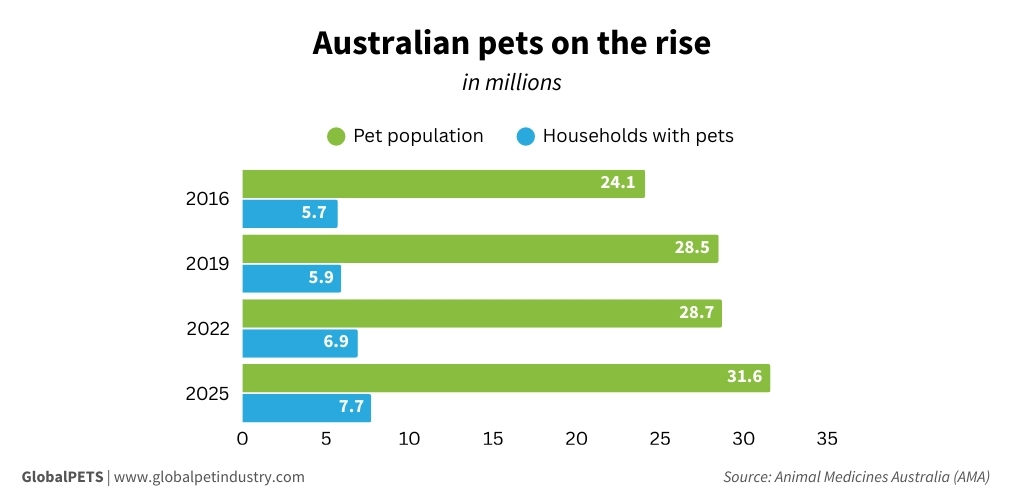
More than 31.6 million pets are living across 7.7 million households in Australia in 2025, according to a national pet population survey by Animal Medicines Australia (AMA) released on 19 September 2025.
This represents 10% growth from 2022, when the country registered around 28.7 million pets and a 30% surge since 2016.
The growth also marks the biggest penetration of pets in households in recent years: in 2025, pets are present in 73% of Aussie homes, rising from 69% in 2022, 61% in 2019 and 62% in 2016 – a sign of consistency after the pandemic boom.
Another indicator of an uptick is that 1 in 5 pet owners (20%) are first-time owners, a similar rate to 2022 and higher than previous years.
The AMA survey was conducted in February and March 2025 and included 2,450 respondents.
Dogs on the rise
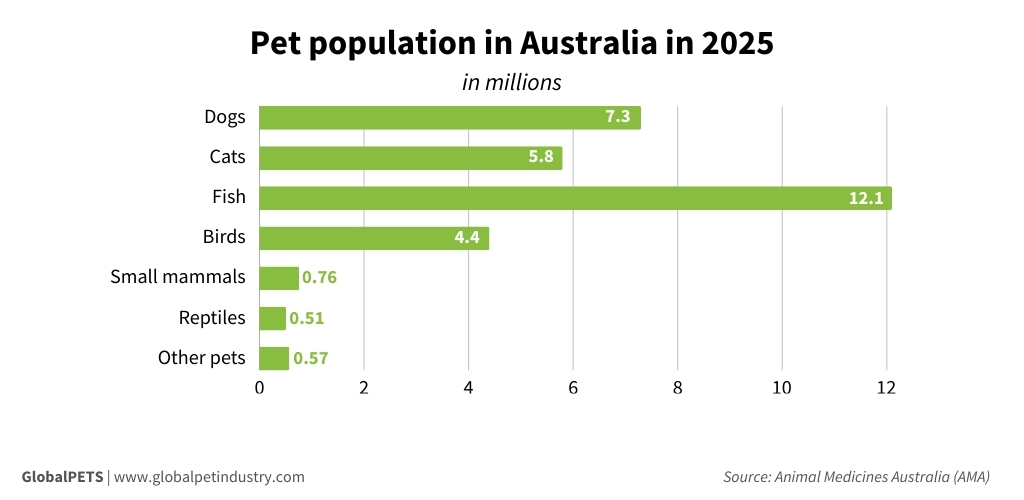
Dogs are the most popular pets in Australia, with nearly half of households owning one. Although at a slower pace, the penetration also increased over the past 3 years, rising from 47.8% in 2022 to 49.3% in 2025.
On the other hand, the cat population, the second most popular pet in the country, remained relatively stable during the period, being present in roughly one-third of families (33.6%).
Although their presence in households has declined slightly, exotic animals are still present in many Australian families. For instance, around 1 in 10 homes keep at least 1 fish (11%) or bird (9%), but they are almost always kept in groups: on average, families keep 10 fish and 4.4 birds at a time.
Breeds that are popular again
Approximately half of Australia’s 7.3 million dogs are purebred, with Labrador retrievers, golden retrievers, German shepherds, border collies, kelpies and Jack Russell terriers being the most popular breeds. This proportion is higher than that recorded in 2022 (44%).
Alternatively, mixed-breed dogs – more likely to have been adopted or rescued – decreased from 39% in 2022 to 35% in 2025.
The survey also showed that 45% of dogs were adopted. Among cats, the rate was much higher, reaching 75%.
Who are the pet owners?
A typical Australian pet owner is a young adult (18-39 years old), living with a family with children (85%), holding a mortgage (85%), and part of a high-income household (81%).
But pet ownership is also high among other groups, such as residents of rural areas (81%) and the LGBTQI+ community (84%).
Although many traits tend to overlap, some contradict statistics. “As in the past, a notable exception is a higher propensity for rural households to have pets despite being more likely to have lower incomes – bucking an overall correlation between income and pet ownership,” the report highlights.
This trait is also reflected in another rate: the percentage of families who own pets is almost the same between those facing financial hardship (74%) and those who are financially comfortable (73%). “This suggests pets are maintained even under financial strain, though specific behaviors (like vet visits) are affected,” the association notes.
Emotional bonds
The primary reasons for owning a pet are often linked to positive emotions. They include the search for companionship, mental health support, relaxation and the mission to give them a home. For owners of fish, birds and exotic animals, the decision is also driven by a hobby.
According to AMA, fun activities shared by owners and pets regained popularity, and some have returned to pre-pandemic levels. Owners like to cook treats for their pets, take them on holiday or road trips and give them gifts on special occasions.
Pet spending in Australia increases by 35% since 2022, reaching A$21.3 billion in one year
Share this story: