Fresh and raw pet food: who’s winning online visibility in the US

New analysis of 20 pet food companies reveals trends in branded and generic search.
Pet owners are paying closer attention to ingredient quality, nutritional benefits and the environmental impact of pet food.
As a result, many turn to search engines to find better options, making it a key way for brands to be discovered and stand out from competitors, according to a new report by UK pet marketing agency Bubblegum Search.
The analysis examined 20 US retailers and manufacturers operating in the fresh and raw dog food segment. The data was collected from the SEO and marketing intelligence platform Ahrefs, proprietary organic traffic analysis and AI overviews monitoring during the fourth quarter of 2025.
Who’s leading?
Subscription-based food producer The Farmer’s Dog has a clear advantage over competitors, with more than half a million monthly visits (539.6K) in Q4 2025.
Then came 4 other manufacturers: Nasdaq-listed Freshpet (144K), California-based JustFoodForDogs (104K), New York-based Spot and Tango (90K) and My Ollie (79K).
While Freshpet and JustFoodForDogs have a solid presence in traditional retailers, Spot and Tango and My Ollie deliver food via meal plan subscriptions. According to the report, they gain visibility “through strong branded demand and expanding educational content rundowns.”
The differences in reach, with a “steep traffic drop-off beyond the top tier,” show a highly concentrated search environment in the US, the report says. This is far more compressed than in the UK, the first country analyzed by the company.
Matt Cayless, founder of Bubblegum Search, tells GlobalPETS that while multi-retailers dominate 85% of American searches, the UK presents a contrasting picture, led by category specialists instead of retail giants.
Branded vs. non-branded
The report highlights differences between branded and generic traffic – that is, clicks from brand-specific searches versus general searches for fresh or raw pet food.
The Farmer’s Dog (89.5%) and Freshpet (79.7%) lean heavily on brand searches, enjoying strong loyalty and awareness, but see less traffic from generic discovery terms.
In contrast, the research finds JustFoodForDogs (57.4% branded/42.6% generic) and My Ollie (64%/36%) balance brand and generic traffic, helping them reach both loyal buyers and early-stage searchers.
Spot and Tango leads in non-branded traffic (84.3%), thanks to its informative nutrition and feeding content.
The growth of AI search
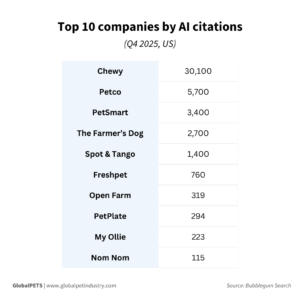
The differences between the UK and the US are even more pronounced when it comes to AI citations.
“US citation volumes are on a completely different scale,” explains Cayless. “Chewy alone is at 30.1K citations, versus the UK leaders at around 3.6K each, which is partly market size and partly the weight those large retailer ecosystems have in US search.”
But Chewy is the exception. Petco, which comes second, has 5 times fewer monthly citations in AI platforms: 5.7K. According to the report, this reflects that the former has a “deep domain trust” and “extensive brand mentions” across the web.
On the other hand, Petco and PetSmart (the latter with 3.4K monthly citations) benefit from “large content ecosystems and strong external authority signals.”
Among specialized brands, The Farmer’s Dog and Spot and Tango are the most monthly cited via AI, due to structured FAQs (Frequently Asked Questions), feeding guides and broad informational coverage.
Barriers
The report finds 5 main barriers that pet companies face when scaling content ecosystems. First, there is no clear ownership among the marketing, e-commerce and performance teams, leading to disconnected strategies.
Then, there are 2 problems related to content consistency: content produced as a one-off project rather than integrated into a structured system, and brands publishing about random topics.
“The report shows content breadth and topical alignment are what drive traffic, not just authority metrics, so without proper hubs you never build momentum,” says the founder of Bubblegum Search.
Overall, the report reveals that brands face competition not just from peers, but from the massive traffic flowing to retailers. Without a clear content strategy, they risk stagnation as AI transforms how pet owners find and evaluate feeding options.
Share this story: