Gen Z and Millennials show stronger interest in large dogs, but smaller pets are adopted sooner

New research among US pet parents highlights affordability and housing challenges shaping adoption decisions.
Smaller pets continue to be preferred when adopting, as 47% of Americans say they would likely adopt a small dog. Another 45% would prefer a medium-sized dog, while 41% would opt for a cat.
Research from Hill’s Pet Nutrition found that, although 23% of people would consider adopting a large dog, these animals take the longest to find a home.
On average, they stay in shelters for 17 days before finding a home. This time drops to 14 days for medium-sized dogs and 10 days for small ones.
These results are based on the Hill’s State of Shelter Pet Adoption Report 2026, which surveyed 2,000 Americans in November 2025 about the perceptions, barriers and motivations shaping adoption decisions.
Younger, higher-income adopters
Preference for large dogs is higher among Gen Z and Millennials (30%), followed by Gen X and Baby Boomers (16%). However, over a third (35%) say they would only consider adopting a larger pet if no other options were available.
Additionally, the majority of respondents (72%) who are likely to adopt large dogs are primarily from higher-income households earning over $50,000 (€47,570) annually.
Overall, 78% of respondents own a dog, while 49% own a cat. Among dog owners, 39% own a small dog, 34% own a medium-sized pooch and 28% own a large one.
Perception of large dogs
Respondents point to challenges that hinder large-dog adoption. Overall, while almost 9 in 10 (87%) owners say they would need significantly more space than smaller dogs, 7 in 10 (70%) find it difficult to secure housing that allows large dogs.
Meanwhile, among those who have not owned a large dog, hesitancy is mainly driven by space and housing constraints (32%), temperament concerns (30%), exercise and energy needs (21%), and time and lifestyle constraints (21%).
Other barriers
Cost and practicality also play important roles in preventing large-dog adoptions.
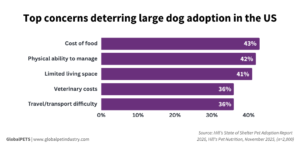
The cost of food ranks highest among those unlikely to get one (43%), while over a third (36%) are concerned about veterinary prices and another 36% say large dogs are difficult to travel with or transport.
While younger Americans (Gen Z and Millennials) are more likely to adopt a large dog, only 53% own a home, compared to 74% among older generations (Gen X and Baby Boomers), and a quarter (25%) live in apartments.
Additionally, 47% of younger adopters have faced pet-related restrictions, mainly linked to financial requirements. For instance, 18% reported deposit fees, and another 18% face monthly pet fees. Meanwhile, 17% encounter pet-size restrictions, and 15% struggle with limits on the number of pets allowed.
According to Hill’s, initiatives that lower the cost of pet ownership are most likely to drive large dog adoptions, with key incentives including reduced adoption fees (34%), free or discounted training (31%) and financial support for upfront expenses (31%).
Share this story:
One click prioritizes GlobalPETS in your search results and AI answers.