Analysis: Share buybacks rise as pet companies seek new ways to reward investors
A GlobalPETS assessment of 14 publicly traded companies reveals how changing valuations and cash strategies are reshaping shareholder returns.
Pet industry companies are diversifying their capital allocation strategies. Financial metrics and recent announcements show that companies connected to the sector are seeking to balance dividends and share buybacks to increase investment returns.
GlobalPETS analyzed the shareholder remuneration strategies of 14 companies based on data from global financial services firm Morningstar, company financial results and official announcements.
Steadily growth
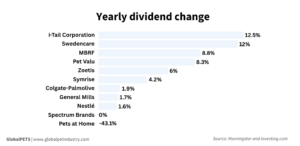
The first is dividend per share (DPS) in the currency declared by companies. Among the selected publicly traded firms that pay dividends, the trend over the last 10 years has been one of constant growth.
This is the case of Colgate-Palmolive, General Mills, MBRF, i-Tail Corporation, Nestlé, Symrise, Zoetis, Pet Valu, Spectrum Brands and Swedencare.
Among the exceptions are Post Holdings, which does not pay a regular dividend. Instead, the American consumer packaged goods company reinvests earnings through stock buybacks.
Also, the British retailer Pets at Home increased its dividend in 2022, kept it stable through 2024, and then decreased it by 43% in 2025.
In April 2026, the company announced a change in the way it pays investors. While the total amount returned to shareholders will remain unchanged, Pets at Home said it would rebase its dividend to a 50% payout ratio, with the remaining cash redirected to share buybacks.
Diversified strategy
Capital return strategies are becoming more diversified: while traditional dividend growth remains dominant in mature companies, a growing number of firms are either entering or reinforcing share buyback programs.
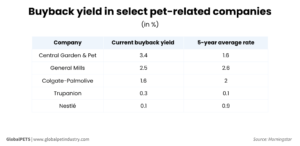
An analysis of the companies’ buyback yields – rates measuring the capital deployed to fund share repurchases in relation to market capitalization – shows that more than half have current rates higher than the 5-year average.
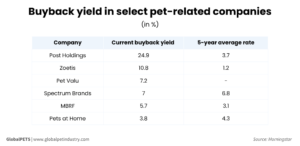
They are Post Holdings, Zoetis, Spectrum Brands, MBRF, Central Garden & Pet and Trupanion. The comparison shows how this mechanism has strengthened in the market.
Repurchase newcomers
A handful of players in the sector recently authorized their first share buyback programs. In the US, Freshpet announced $150 million (€131M) in share repurchase authorization in May 2026.
Chief Financial Officer John O’Connor said the decision “reflects our strong financial position and balance sheet.” 2025 marked the first full fiscal year in which the manufacturer generated positive free cash flow (FCF).
Despite using this reinvestment mechanism to “capture the large and growing opportunity in fresh pet food,” the company also opted for it because it believes that “our stock trades below intrinsic value,” the CFO added. An earlier analysis by GlobalPETS showed that some pet-related companies’ valuations reached multi-year lows.
At the beginning of the year, Symrise also launched its first-ever share buyback program of up to €400 million ($458M) to be rolled out between 1 February and 31 October 2026.
“At today’s valuation, Symrise shares represent a highly attractive, low‑risk reinvestment opportunity for the Company. This buyback is expected to be supportive of our long‑term leverage ambitions,” CEO Jean‑Yves Parisot said.
Share buybacks gain momentum
The mechanism also expanded among companies that had already adopted it. At the end of 2025, Zoetis announced its intention to make additional repurchases of common stock, beyond the existing multi-year $6 billion (€5.2B) repurchase program launched in 2024.
In April, Chewy’s Board of Directors approved a $500 million (€437M) increase in its share repurchase program. This expansion added to the remaining $119.4 million (€104M) in repurchase authorization from a program that began in 2024.
More recently, after closing the financial results for its fiscal year 2026 in May, BARK’s Board of Directors also authorized a new share repurchase program of up to $40 million (€35M) to be funded by ongoing free cash flow.
On the other hand, General Mills decreased its share repurchase activity recently. During fiscal 2026, ended 31 May, it totaled $500 million (€437M) compared to $1.2 billion (€1B) in repurchases a year ago.
Undervaluation drives rise
Just like Freshpet, American retailer Central Garden & Pet authorized the repurchase of an additional $100 million (€88M) of the company’s common stock and Class A common stock – with unique voting rights – in February “because management considers the market price of its shares to be currently undervalued,” it said in a statement.
In summary, the analysis shows that even though dividend policies have grown steadily, an increasing number of companies are allocating more capital to share buybacks, either to utilize excess cash or to correct unsatisfactory stock prices.
Share this story:
One click prioritizes GlobalPETS in your search results and AI answers.