Germany’s pet population declines slightly in 2025, sales hold steady

Food accounts for the majority of revenue, while accessories decline amid an overall flat market.
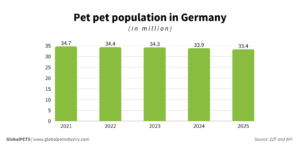
Germany’s pet population reached 33.4 million in 2025, excluding fish and reptiles, with 43% of households owning at least 1 pet, according to the German Pet Trade & Industry Association (ZZF) and the Industrial Association of Pet Care Producers (IVH). In 2024, Germany had 33.9 million pets, with 44% of households owning them.
The data shows a slight decline in pet ownership in Germany in recent years. In 2022, there were 34.4 million pets, with 46% of households owning at least 1. This figure remained relatively stable in 2023, with a small decrease to 34.3 million pets and 45% of households.
The 2025 data is based on a survey of 5,000 homes, combined with market data from IVH and ZZF member companies.
Ownership dynamics
Pet ownership varied by household size in 2025. Around 26% of pets lived in single-person households, compared with 35% in 2-person households and 39% in households with 3 or more people.
By age group, those aged 60 and older comprised 25% of pet owners, followed by those aged 50-59 (21%). Ownership rates were lower among younger groups, at 19% for those aged 30-39, 18% for those aged 40-49 and 17% for those aged 29 or younger.
In addition, 67% of families with children owned a pet, while 13% of all households kept at least 2 different types of pets.
Pet preferences
Cats remain the most popular pets in Germany, with 15.7 million living in 1 out of 4 households in 2025. Dogs follow, with a population of 10 million across 1 out of 5 homes. Both categories saw a slight decline from 2024, when there were 15.9 million cats and 10.5 million dogs.
The population of small animals – such as rabbits, guinea pigs, hamsters and mice – rose marginally to 4.4 million, now present in 5% of households, up from 4.3 million the previous year.
Bird and aquarium ownership recorded a slight increase. While birds went from 3.2 million in 2024 to 3.3 million in 2025, fish went from 2 million to 2.1 million. Terrariums declined slightly to around 1 million, representing 1% of households.
Pet industry revenue
Industry revenue has remained flat in recent years. In 2025, the German pet market reached €6.99 billion ($8.2B), slightly down from €7 billion ($8.2B) in both 2024 and 2023, but still above €6.5 billion ($7.6B) in 2022 and €6 billion ($7B) in 2021.
Pet food generated €4.3 billion ($5B) in 2025, marking a marginal 0.3% year-over-year (YoY) increase, while the pet accessories segment declined by 4.6% YoY to €1.1 billion ($1.2B).
Total brick-and-mortar sales reached €5.3 billion ($6.2B), while online sales totaled €1.5 billion ($1.8B). Food for wild birds contributed an additional €134 million ($157M).
The associations say that online sales continue to gain importance, with a 0.6% increase from 2025 and 26% higher than 2022, although no species-specific breakdown is currently available.
Pet food and accessories
Cat food remained the largest category, generating €2.3 billion ($2.7B) in sales, with wet food accounting for €1.6 billion ($1.8B). Dog food followed at €1.7 billion ($1.99B), led by snacks, which contributed €768 million ($899M).
Sales of bird food, ornamental fish food and small animal food collectively reached €204 million ($239M). Food retail channels accounted for 66% of total sales, with the remainder generated through specialized pet stores.
Cat litter led the accessories category with €370 million ($433M) in sales, followed by cat accessories at €230 million ($269M) and dog accessories at €200 million ($234M).
Specialized retailers remained the dominant channel for accessories, accounting for 76% of sales, with the remainder coming from food retail outlets.
Share this story:
One click prioritizes GlobalPETS in your search results and AI answers.