How multi-phase drying technology solves the premium pet treat manufacturing dilemma
New trial data reveals how a single automated line efficiently handles three distinct pet formats.
The modern pet treat market is moving fast. Today’s pet parents increasingly demand clean-label transparency, expecting to easily recognize raw ingredients while seeking minimally processed, high-nutrition options.
However, scaling up to meet this premium demand introduces significant operational challenges for manufacturers. Traditional drying systems often force processors to choose between high-volume throughput and raw nutritional integrity.
To solve this industry-wide challenge, a series of trials evaluated how a single, highly versatile technology, the QDS Bake® system, can efficiently process three vastly different product formats on a single line, ranging from delicate, low-temperature raw BARF snacks to high-throughput, high-temperature treats.
The clean-label formulation challenge
To simulate the exact parameters of premium marketplace trends, researchers developed a unique, additive-free formulation combining animal protein, bones, cartilage, organs, and vegetables.
Because it completely avoids functional ingredients, binders, or artificial additives, the formulation provides high nutritional value but remains highly sensitive to thermal oxidation and visual deterioration.
To align with modern consumer expectations, a large piece size was purposefully chosen for the raw ingredients to provide a natural, minimally processed appearance.
One system, three processing profiles
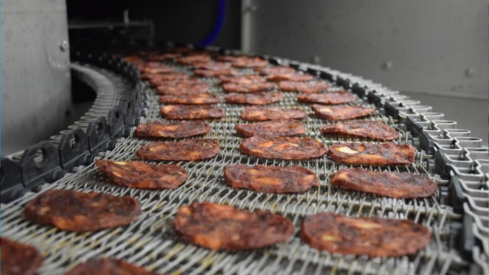
Testing was conducted at Metalquimia’s innovation center in Girona, utilizing an industrial-scale prototype of the QDS Bake® system. The system’s unique design features highly efficient air-treatment capabilities that operate dynamically across a broad range of temperatures and humidity levels.
To demonstrate its format flexibility, the exact same base recipe was subjected to three distinct thermal treatments:
- Low-Temperature BARF Profile: Dried at low temperatures without cooking the piece to preserve raw properties.
- High Temperature 1 (HT1): A four-phase moderated thermal profile incorporating a steam-cooking killing step.
- High Temperature 2 (HT2): A rapid, high-intensity heat profile reaching up to 100°C.
Table 1: Drying processes conducted during BARF, high temperature 1, and high temperature 2 tests.
| BARF | |||||
| Phase | Temperature | Relative humidity | Duration | Water activity | Loss |
| 1 | 30ºC | 20% | 16 hours | 0.68 | 68% |
| High temperature 1 (HT1) | |||||
| 1 | 60ºC | 10% | 60 min | 0.75 | 68% |
| 2 | 78ºC | 90% | 15 min | ||
| 3 | 70ºC | 20% | 120 min | ||
| 4 | 75ºC | 10% | 210 min | ||
| Total duration | 6.75 hours | ||||
| High temperature 2 (HT2) | |||||
| 1 | 70ºC | 10% | 60 min | 0.75 | 78% |
| 2 | 85ºC | 90% | 15 min | ||
| 3 | 95ºC | 5% | 120 min | ||
| 4 | 100ºC | 1% | 120 min | ||
| Total duration | 5.25 hours | ||||
The productivity paradox: why hotter isn’t always better
For continuous lines trying to meet surging global demand, maximizing throughput is critical. While higher processing temperatures naturally accelerate moisture evaporation, the study exposed a vital counterintuitive yield dynamic:
- The BARF bottleneck: While low-temperature drying maximizes nutritional value and limits shrinkage, it requires a 16-hour commitment. This drops the continuous line’s productive capacity by approximately 58% compared to high-temperature runs.
- The HT1 vs. HT2 yield dynamic: Despite taking 1.5 hours longer to execute than HT2, the moderated HT1 process achieved an 11.6% higher total production throughput.
- The science behind the loss: At extreme temperatures (HT2), the food matrix experiences rapid protein denaturation and fat melting. Rather than evaporating water, these high temperatures cause actual proteins and fats to bleed out, resulting in a 10% lower product yield for HT2 compared to HT1 without assisting in water activity aw reduction.
Production Tip: If the recipe were adapted to include refined ingredients with water-holding capacities (such as fibers or starches), the target aw could be reached at higher relative humidity levels, which would further boost final product yield.
Aesthetic and compositional quality
Drying is the definitive phase that establishes a pet treat’s final shelf-stable appearance.
Increasing the heat profile accelerates product shrinkage and yields a significantly darker colored slice. Because this clean-label recipe contains zero artificial color-fixers or preservatives, utilizing automated systems like the QDS Bake® to moderate temperature thresholds serves as an essential tool to minimize oxidation and food deterioration.
To understand how each profile impacted nutritional composition, final samples were assessed using Near-Infrared (NIR) analysis and compared against the initial raw mixture:
Table 2: NIR analysis results for the raw product and the different end products.
| COLLAGEN | FAT | MOISTURE | PROTEIN | SALT | |
| Raw | 1.86 | 6.13 | 71.73 | 20.03 | 1.85 |
| BARF | 3.96 | 9.00 | 19.70 | 55.74 | 2.72 |
| HT1 | 4.31 | 19.97 | 23.45 | 48.00 | 2.97 |
| HT2 | 5.65 | 16.94 | 21.22 | 45.00 | 4.17 |
Moisture reduction inherently concentrates ingredients to yield high-protein treats. However, the extreme heat and steam cooking integrated into HT1 and HT2 led to measurable protein degradation (denaturation and oxidation) and fat melting, culminating in lower final protein levels relative to the low-temperature BARF format.
Molecular fingerprints via FTIR
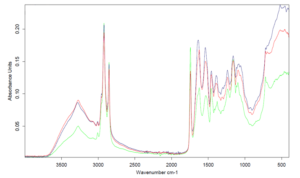
To confirm these structural changes, an FTIR spectral analysis was executed using a Bruker Alpha II device. The data validated that the most distinct molecular shifts occurred when comparing the un-cooked BARF treats directly to the high-temperature alternatives.
- The correlation probability showed a 94.5% match between BARF and HT1, and a 94% match between BARF and HT2.
- HT1 and HT2 shared a closer 96% molecular correlation, proving that structural changes in the food matrix strictly accelerate as processing temperatures climb.
Validated biological safety
Achieving ambient shelf stability requires dropping water activity aw below standard thresholds.
While food safety regulations allow a maximum threshold of 0.85 for non-refrigerated products when used alongside barriers like modified atmosphere packaging, most commercial manufacturers dry to significantly lower levels to prolong product shelf life.
All processes in this study successfully achieved the target water activity ($a_w$) threshold of 0.76 set for completing the tests (verified using an Aqualab Pre device).
For the cooked formats, an active steam-cooking phase was introduced to serve as a biological “killing step” designed to destroy as many pathogens as possible.
A formal microbiological challenge test conducted by the expert body Campden BRI (Chipping Campden) proved that the QDS Bake® system is capable of delivering a substantial 6.8 log reduction of Enterococcus faecium (utilized as an innocuous analog for Salmonella spp.) when maintaining a product temperature above 91°C for 10 minutes.
Conclusion: A new standard for smart factories
The modern pet treat facility can no longer afford to rely on rigid, single-format machinery. As consumer trends fluctuate between raw BARF products and cooked high-capacity treats, process versatility is a necessity.
The QDS Bake® technology demonstrates that by combining multiple customized drying phases into a single continuous run, manufacturers are no longer constrained to one product type.
Offering a 100% automated system that requires minimal operator intervention beyond high-level monitoring, it delivers a turnkey solution that achieves optimized production costs, meticulous traceability, and food safety.
Share this story:
One click prioritizes GlobalPETS in your search results and AI answers.