Inflation snapshot: Pet inflation holds firm in February with further rises expected

Prices continued an upward trend across key markets, while the outlook points to escalating risks from geopolitical conflict and logistical constraints.
While January began by normalizing the up-and-down movements of 2025, February showed no divergence: all prices for pet food, supplies and services monitored in the 5 markets by PETS International rose month-on-month (MoM).
Europe
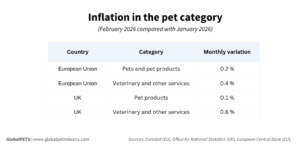
In the European Union, the average Consumer Price Index (CPI) rate for pets and related products rose 0.2% in February 2026 compared to January.
Data from Eurostat, the official statistical office of the European Union, shows that Estonia and Latvia had the largest surges in this category during this period, at 4.9% and 2.8%, respectively. Both countries saw sharp price declines in January, which point to normalization.
On the other hand, the largest declines were recorded in Cyprus (-1.7%) and Finland (-1.4%).
Veterinary and other services for pets saw a higher increase in the EU, at 0.4%. Slovenia was the most affected country by far, at 9%, a price rise almost 3 times that recorded in Slovakia (3.4%).
Bulgaria was the only country to see a decline in the category, as costs fell 0.3%.
For the economy as a whole, after opening the year with falling prices, both the European Union and the Eurozone recorded a 0.6% increase in the general CPI in February, driven by higher costs for services, food, alcohol and tobacco, and non-energy industrial goods.
UK
In the UK, prices of pet products maintained the same upward pace as the previous month, with a slight 0.1% increase. However, veterinary and other services for pets’ CPI accelerated, rising from 0.1% in January to 0.6% in February.
On average, goods and services in the country rose by 0.4%, driven by clothing and offset by motor fuels.
The Office for National Statistics (ONS) included pet grooming in its official inflation calculation in March. This means that price changes in this category will now contribute to the overall index.
“Pet grooming has been added to reflect a growing area of the pet care market. Reports indicate that this service attracts the second-highest spend in the sector behind health checks, which we already cover with the inclusion of annual booster injections,” the ONS says.
Other pet-related items included in the basket are cat and dog food, dog treats, wild birdseed, pet collars, animal cages, small pets, annual booster injections, dog kennel boarding fees, and pet insurance.
US
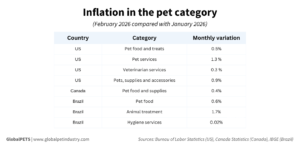
The US registered increases across all of its monitored categories. Pet services led the surge, with a 1.3% MoM price increase. It was followed by pets, supplies, and accessories, which rose 0.9% in February after opening the year with a 1% decline.
Pet food and treats also saw a more moderate increase from January, at 0.5%. Vet prices saw the lowest impact, at 0.3%.
The general CPI accelerated slightly, rising 0.3% in February after a 0.2% increase the month before, driven by certain sectors.
“The index for all items less food and energy rose 0.2% in February. Indexes that increased over the month include medical care, apparel, household furnishings and operations, airline fares, and education,” says the US Bureau of Labor Statistics (BLS).
Canada
In Canada, the monthly uptick in pet food and supplies prices returned to normal after rising 2.3% in January. In February, prices increased 0.4%.
Inflation for all items rose slightly, to 0.5%. According to the Canadian government, the CPI was affected by the end of a tax benefit in effect from 14 December 2024 to 15 February 2025. “As a result, consumers paid more for affected products,” it says.
Brazil
In Brazil, while hygiene services had the highest rise in the previous month (1.1%), they registered the smallest increase in February, at 0.02%.
Pet food came second, as prices rose 0.6% monthly. Veterinary treatment became more expensive, at 1.7%.
The average inflation rate in the country was more than double last month, at 0.7%. According to the Brazilian Institute of Geography and Statistics (IBGE), this was the largest monthly increase in a year, influenced by adjustments in school tuition fees.
Inflation outlook
Overall inflation is expected to rise further this month and in the coming months, as tensions in the Middle East between Iran, the US and Israel affect economies, supply chains and logistics.
Financial institutions such as S&P Global and ING project inflationary pressures in big economies such as Europe and the US arising from both the conflict and ongoing tariff effects.
“The risk of a potential energy shock arising from the war in the Middle East widens the distribution of potential inflation outcomes to the upside. Such a shock would cause headline inflation to spike, it would squeeze real consumption and it would spur the Fed to raise its bar for policy easing,” S&P says about the US.
In Europe, the high dependence on imported LNG (liquefied natural gas) is the largest contributor to the forecast. “ While we had expected inflation to remain below 2% for most of the year, the risk to the outlook is clearly up due to the war in the Middle East causing energy supply disruptions and soaring energy prices,” ING says.
“The longer the conflict goes on, the more impactful this will be for eurozone inflation and economic growth,” it adds.
An analysis from the capital markets firm Jefferies, shared by Seeking Alpha, also forecasts inflationary impacts on packaged food due to escalating freight, packaging and processing costs.
Share this story: