Inflation snapshot: Pet prices tick up in October, led by vet services
The US, UK, Brazil and the Eurozone see costs rise for pet supplies, food and services, while Canada experiences a drop.
The costs associated with owning a pet have risen in the US, UK, Brazil and the Eurozone over the past 2 months.
However, out of all the countries and regions analyzed – Europe, UK, US, Canada and Brazil – only Canada has seen a decrease in prices.
In countries that disclose prices for subsectors, the largest increases were driven by veterinary services. The category has struggled to stabilize prices in several economies in recent years.
Inflation has been one of the biggest issues for consumers and a major obstacle for companies this year, as they work on pricing strategies to increase volume growth.
Europe
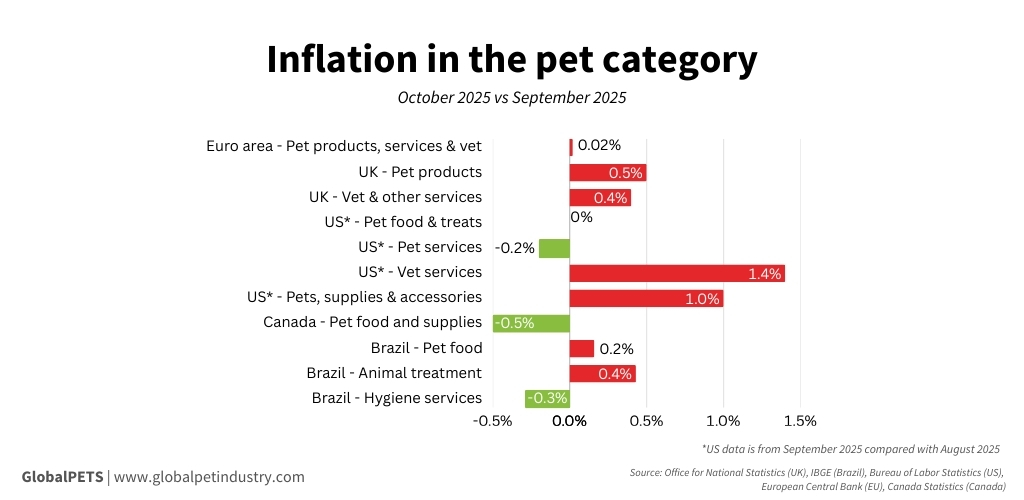
The Harmonized Index of Consumer Prices (HICP) for October covering pets, pet products, services, and veterinary care recorded a modest month-on-month increase of 0.02% compared with September. This figure was significantly lower than the overall euro area index, which reported a monthly increase of 0.2%, driven by services and food, alcohol and tobacco.
In the past 12 months, pets, pet products, services and veterinary prices increased 1%. The European Central Bank (ECB) also releases the annual change of only veterinary and other services. In this cut, the increase was much higher: 3.1% year-over-year (YoY).
On 17 November, the European Commission published its Autumn 2025 Economic Forecast, revising euro region inflation slightly upward from the Spring Forecast. It now expects inflation to fall from 2.4% in 2024 to reach the ECB’s 2% target in 2027.
Brussels officials expect decreases in services and food inflation, especially due to competitive pressure from imports and the appreciation of the euro.
UK
The Consumer Price Index (CPI) figures for October show that the price of veterinary and other services increased 0.4%.
The increase was the same as that recorded in the country’s overall index. Prices for pet products increased slightly more, by 0.5% monthly.
In 12 months, however, prices of veterinary and other services jumped 6.3%, well above the general services inflation (4.6%) and the average of all items (3.8%). Prices for pet products, on the other hand, saw a smaller annual increase of 2.6%.
US
The US Bureau of Labor Statistics (BLS) should have released its October data on 13 November, but due to the recent government shutdown, the data have not yet been processed. The last update was made on 24 October 2025 with data from September.
Month over month (MoM), pet food and treats prices remained stable. YoY, however, there was a 0.5% increase.
The BLS also measures figures for purchase of pets, pet supplies and accessories, which increased 1% MoM and 1.5% YoY.
Veterinarian services are the pet category with the biggest leap in the country: a 1.4% monthly increase and a 7.8% yearly increase.
On the other hand, other pet services registered a -0.2% monthly decrease in prices. Yearly, however, the increase was 5.1%.
The general index increased by 0.3% in September, according to the institution. Over the last 12 months, the rise was 3%.
Canada
The October CPI for pet food and supplies decreased compared with both the previous month (September 2025) and the same month in 2024.
The MoM percentage drop was -0.5%, while the YoY was -1.2%.
The deflation goes against the overall result of the index, which showed an increase of 0.2% from September and 2.2% over October last year.
Brazil
The Brazilian CPI has three indicators for inflation in the pet category: animal treatment (clinic), hygiene services and food.
The largest monthly price increase in October was recorded in treatment (0.43%), followed by the pet food sector (0.16%). Hygiene services, on the other hand, saw a decrease of -0.29%. The general inflation index increased 0.09%.
The Brazilian government does not release a YoY comparison; instead, it releases the accumulated variation within the year. From January to October, clinical treatment prices increased by 3.79%, and hygiene services by 5.63%.
On the other hand, pet food presented an accumulated decrease of -4.23%.
Share this story: