Inflation snapshot: Pet supplies prices start 2026 on a mixed trajectory

GlobalPETS examines the rises and falls in Consumer Price Index (CPI) rates across Europe, the UK, the US, Canada and Brazil.
The first release of Consumer Price Index (CPI) rates in 2026 indicates a non-uniform direction across countries.
In 2025, pet products and food offered relief to consumers. In almost all countries analyzed by GlobalPETS, they rose moderately last year. On the other hand, services, particularly veterinary, outpaced the average inflation rate.
In January 2026, the divide was less pronounced than before. Although the UK and the US recorded moderate changes in pet-related services, in Brazil, hygiene services rose at a pace three times higher than the country’s average inflation rate.
A similar movement was seen in goods: while pet product prices in Europe remained almost stable, Canada saw the category surge.
Europe
In the European Union, the average CPI rate for pets and related products rose 0.1% in January 2026 compared to December 2025, the same rate registered in the Euro Area.
Data from Eurostat show Ireland had the largest surge in the period at 2.3%, followed by Bulgaria and the Netherlands, both at 1.6%. The neighboring countries, Estonia and Latvia, registered the biggest decreases in prices, at 5.4% and 2.7% respectively.
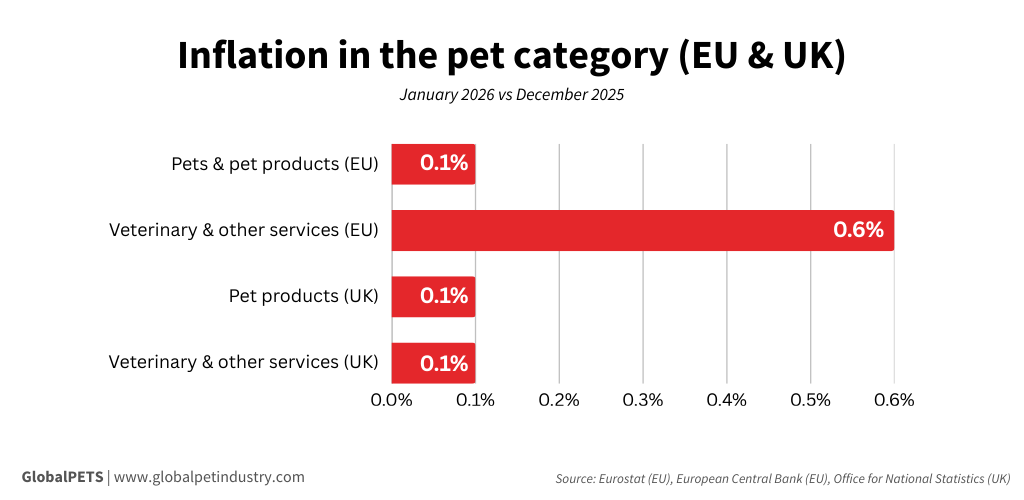
Veterinary and other services for pets saw higher increases in the EU and the Eurozone, at 0.6% in both. While Bulgaria (5.7%) and Lithuania (2.7%) faced greater price pressures, Luxembourg was the only country to see relief, with prices declining by 0.1%.
The average figures are moving in the opposite direction to the decline recorded in the overall economy. The EU started the year with a 0.4% month-over-month decrease in the general CPI, while in the Euro area, prices fell a bit more sharply, by 0.6%.
UK
In the UK, prices for both pet products and veterinary and other services for companion animals rose slightly in January, by 0.1% from December.
However, they differ in their annual rates. Over the last 12 months, prices for pet products rose 0.9%, while veterinary care and other services jumped 5.5% in the same period.
The national CPI rate declined by 0.3% in January, while over the 12 months before, it rose by 3.2%.
US
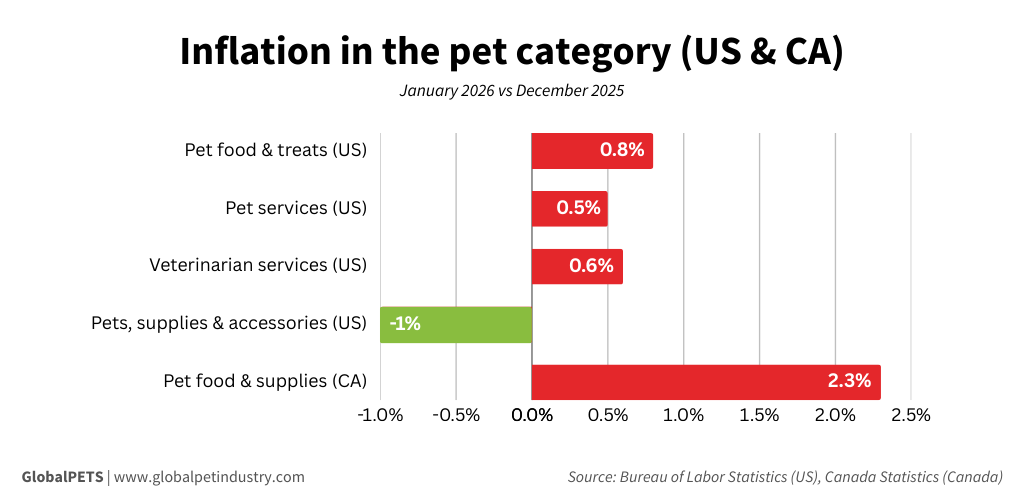
Price movements in the US varied across categories. For instance, while the CPI for pet food and treats increased 0.8% in January compared to December, purchases of pets, pet supplies and accessories decreased by 1% in the same period.
For the first time in the past few months, pet-related services registered a smaller increase than goods. While general services saw a 0.6% rise in the first month of the year, vet services increased 0.5% compared to December.
The general CPI rose slightly in the country, by only 0.2% month over month. According to the US Bureau of Labor Statistics, “The index for shelter [measuring rents] rose 0.2% in January and was the largest factor in the all items monthly increase.”
Canada
In Canada, pet food and supplies prices jumped 2.3% in January compared to December. The increase comes from a low base, as the country ended 2025 with an annual CPI rate of -1.2%, indicating a normalization of prices.
In a year-over-year comparison, the increase was much smaller, at 0.1% relative to January 2025.
Inflation for all items, on the other hand, followed the opposite trajectory: despite remaining unchanged from December 2025, the increase from January last year was 2.3%.
Brazil
In Brazil, pet food saw the smallest increase among animal-related items, at 0.38% in January. This category was followed by animal treatment, at 0.53%. Hygiene services had the highest rise, at 1.1%.
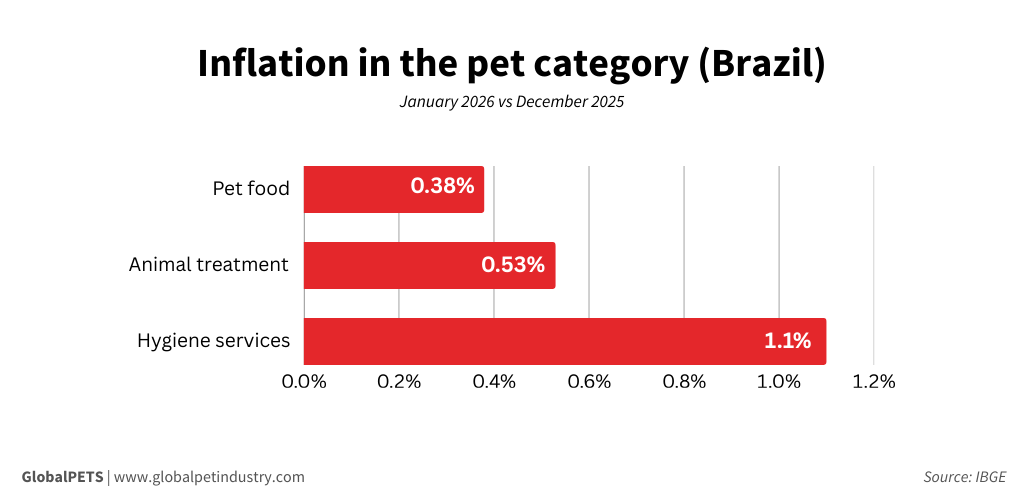
All items rose more than the country’s overall average inflation rate of 0.33% during the period, indicating pressure on pet owners’ budgets.
Global scenario
In 2026, economies across the world can expect a general cooling of inflation, according to an analysis by J.P. Morgan. “A phase of sticky inflation reflecting common global dynamics is ending,” says Bruce Kasman, Chief Global Economist at the investment bank, reflecting better conditions in the supply chain and commodity prices on average.
The institution adds, however, that this is not the rule for all countries, as “there will likely be disparate outcomes across regions, with inflation projected to accelerate in the US and moderate in Europe,” especially due to tariff effects and a weaker dollar.
Share this story: