International shoppers prefer global over American brands, Ipsos says

New research reveals a decline in trust and purchase intent for brands perceived as American – except in the US itself.
In 2025, if international customers recognize a brand as American, they may choose not to buy it. What was once synonymous with quality and an object of desire is now viewed with caution by consumers from foreign countries, according to a study by Ipsos.
A new report from market research firm Ipsos concludes that there’s an average negative impact of 22 points on trust in American products in non-US markets. According to the Brand America 2025 report, there is a negative impact of 21 points on purchase intent for brands perceived as American.
The perception is negative across all countries surveyed (except for the US), but some stand out. The countries with the highest rejection rates are the United Kingdom and Canada.
As GlobalPETS reported earlier in the year, researchers found that 42% of Canadian consumers surveyed say they would “absolutely do everything” to avoid purchasing products from the US and American companies.
To elaborate on the report, Ipsos conducted a survey of 9,012 respondents across China, Brazil, the UK, France, Germany, Canada, Japan, Mexico, India and the US between May and June.
American vs. international
Perceptions change when consumers see brands as “international” rather than “American.” According to the report, across all 10 countries surveyed, those who perceive a brand as ‘international’ are more likely to trust it and to say they would purchase it.
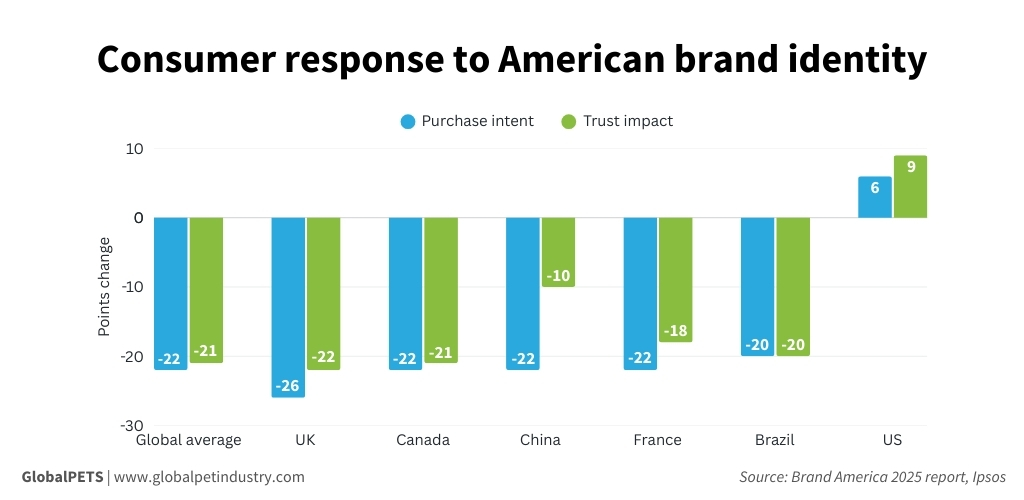
Within the US, on the other hand, its own brands appeal to consumers. If they associate them with the country, the willingness to buy increases by 6 points, and trust increases by 9.
The top brands associated with the United States are Apple (in China, Mexico, UK, Canada, India and Japan), Nike (in Brazil), Coca-Cola (in France and Germany) and Ford (in the US).
What about pet brands?
The “American-ness” associated with brands in the popular imagination has its limits.
“The decision to buy pet food is fundamentally different from buying a smartphone or a pair of jeans, which means the findings of the Brand America report don’t apply in a simple, direct way,” Kristy Click, Senior Vice President and Senior Client Officer at Ipsos in the US, tells GlobalPETS.
The difference arises mainly from the factors that motivate pet food purchases, says the Vice President: trust, safety and health. “This emotional, high-stakes purchasing decision often overrides broader geopolitical sentiments,” she adds.
Pet owners rarely change their pet’s food because of concerns about digestive problems or other health consequences. Click notes that owners are more loyal to pet food brands than to their own, creating a “strong defense for established brands, regardless of their national origin.”
Other factors also impact the purchase decision, such as personal recommendations from veterinarians and national or supranational regulations.
“The European Union, for example, has its own comprehensive and strict set of regulations for pet food. […] Supply chain issues, import rules, and competition from strong local players can limit the availability of American brands, influencing whether consumers can even develop a preference for them,” Click explains.
Top American pet brands
The performance of market giants corroborates this explanation. Purina, from Nestlé; Whiskas, from Mars; Hill’s Pet Nutrition, from Colgate-Palmolive; and Blue Buffalo, from General Mills, are US-born brands.
Apart from Blue Buffalo, the other 3 appear among the top 15 preferred dog and cat food brands in Brazil, Canada, France, Mexico, the UK and the US, according to a survey by Loop of 3,081 pet owners in August.
But pet food ownership is not straightforward. Many brands started locally, but were acquired by one of the pet food super-producers. This means that distinguishing or attaching a nationality to a brand in this segment can be a difficult task for consumers.
What does it mean for brands?
Knowing about this is crucial for American businesses operating in other countries, Ipsos says, as it could “potentially be damaging, while the degree to which your competitors are perceived as ‘American’ could present a real growth opportunity.”
This should calibrate how brands communicate with customers, the company states, suggesting that a message of contributing to causes, communities or collaborating with the local market can help mitigate the negative effect.
However, it is necessary to find a balance between focusing the communication strategy “without abandoning their core brand identity,” the report concludes.
Share this story: