Pet industry voices concern as US rules out renewal of free trade deal with Canada and Mexico
The USMCA remains in force until 2036, but industry groups warn that annual reviews could undermine trade stability and create uncertainty.
The US has announced it will not extend the United States-Mexico-Canada Agreement (USMCA) for another 16-year term beyond its July 2036 expiration.
The free trade agreement (FTA) facilitating commercial relations between the 3 countries will remain in force for the next decade until it expires, provided that no member withdraws.
The decision “triggers the annual joint review process, which will proceed each year until the Parties either agree to an extension or the Agreement expires on July 1, 2036,” according to the global law firm White & Case.
In a statement, US trade representative Jameson Greer says the country will continue discussions with Mexico and Canada on the deal’s shortcomings and trade deficits in the region. “As previously announced, the United States will meet with Mexico the week of July 20 for a third round of bilateral negotiations related to the USMCA joint review.”
The USMCA entered into force on 1 July 2020, replacing the North American Free Trade Agreement (NAFTA), which had been in effect since 1994. It modernized NAFTA by strengthening disciplines on currency manipulation and reforming food and agricultural trade, among other measures, while retaining the elimination of nearly all tariffs and most non-tariff barriers to trade in the region.
Industry reaction
The American Feed Industry Association (AFIA) released a statement saying that it is “troubled” by the US’s decision. It notes that while the deal is “not without flaws,” it served as “a cornerstone of growth and stability for the animal feed and pet food industry” and should not be allowed to expire in the next 10 years.
In addition, the association emphasizes that while bilateral agreements may address specific issues, they cannot fully replicate the efficiencies of a single, integrated North American market.
“The AFIA supports the administration’s goal of strengthening the United States’ position under the USMCA. However, because the agreement will remain in effect unless the United States formally withdraws, annual reviews through 2036 would erode the predictability businesses need to invest and compete,” Constance Cullman, President and CEO of AFIA, says.
“The administration should prioritize negotiations now to secure a long-term renewal that provides lasting certainty for North American trade,” she adds.
Stability and market access
Ahead of the US government’s announcement on the future of the USMCA, the Pet Food Institute (PFI) joined 160 agricultural organizations in urging its renewal.
According to the institute, the deal has provided stability, predictability and science-based market access in Mexico and Canada for US producers.
“Rather than creating entirely new opportunities, the agreement has helped ensure that pet food manufacturers can continue investing, exporting and operating across an integrated North American market with confidence,” the pet food trade association tells GlobalPETS.
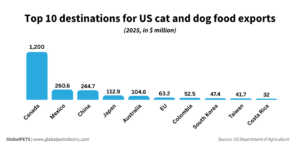
In 2025, Canada accounted for approximately 48% of US pet food exports, while Mexico represented about 10%, making North America the foundation of US pet food trade.
Trade stability
Tariff-free trade among the 3 countries is USMCA’s most significant benefit for the pet food sector. According to the PFI, this helped manufacturers remain competitive while avoiding higher costs that could ultimately be passed on to consumers.
If the deal is not extended, the association says the most immediate consequence would be increased uncertainty over trade between the countries.
“[This] could create inefficiencies for American pet food exporters who depend on stable trade rules to effectively manage supply chains and maintain long-term contracts and business relationships,” it concludes.
Share this story:
One click prioritizes GlobalPETS in your search results and AI answers.
