Pet investment cools in 2025 as investors turn cautious

While early-stage investment slowed last year, M&A activity and sponsor exits could drive a rebound in 2026.
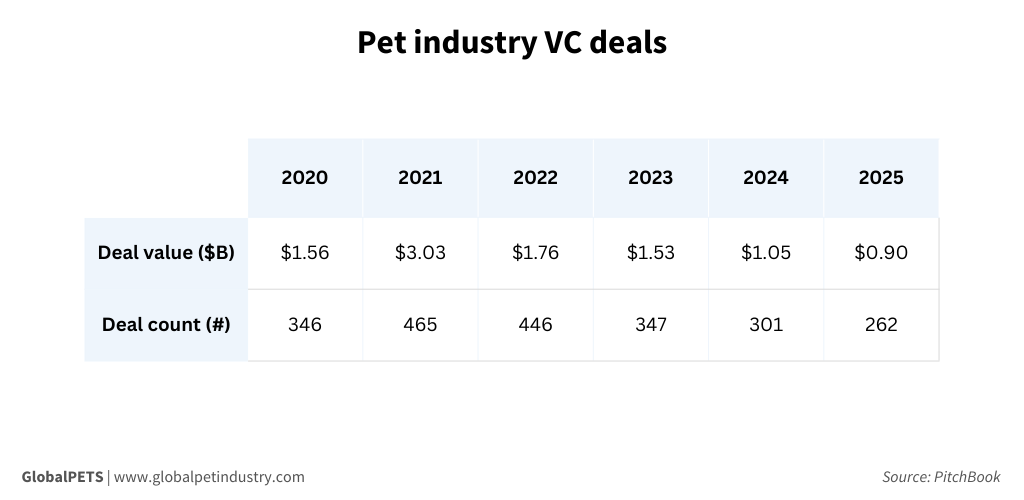
The global pet industry attracted $899.5 million (€755M) in venture capital (VC) investments and acquisitions in 2025, according to PitchBook, which recorded 262 deals.
The value is 14.2% lower than the 2024 level, when it reached $1.1 billion (€0.88B). The number of deals decreased at a slightly slower pace, 13% since that year, when it registered 301 transactions.
2025 has been the quietest year in this decade (from 2020 onward) for VC investments, according to PitchBook’s data. Data show 346 pet-related deals in 2020, 465 in 2021, 446 in 2022 and 347 in 2023.
European activity
In 2025, Europe recorded 62 deals, a 22.5% drop from 2024, when it reported 80. The decline was even greater compared to 2020, at 42.6%. Deal value, on the other hand, was 43% higher than in 2024, at $267.3 million (€224.4M).
The UK saw the two biggest deals in the European market last year. The highest value was the $50 million (€46M) capital injection on British fresh cat food producer Katkin, announced in December. The funding will support the company’s expansion across the UK to scale its direct-to-consumer (DTC) and pet specialty retail channels.
It was followed by a $23.8 million (€20M) investment in Napo, a London-based pet insurance provider, in February.
US
The US market registered more intense activity than Europe, with 78 deals totaling $411.2 million (€344M). Despite this, these are the lowest figures in the last 6 years. Compared with 2024, both the number and value of deals are down by approximately 18.7%.
In March, Petscreening, the operator of a pet management platform intended to screen renters’ pets and validate the status of assistance animals, received a $75 million (€63M) investment, making it the largest VC deal in the American market.
Modern Animal, a veterinary clinic chain based in California, received the second-largest investment in September: $46 million (€38M).
What funds are seeking
Anna Skaya, General Partner at the independent pet-focused venture capital fund AniVC, says that VC investors are looking for an early path to profitability, as well as real proof of demand and PMF (product-market fit).
Another factor that differentiates a successful pitch from a failed one is the founder’s understanding of consumer behavior.
“It’s easier than ever with AI to put together a pitch deck, so the real work is separating companies that can scale within a venture model from ideas that still need time,” Skaya tells GlobalPETS.
Promising segments
Overall, pet health stands out as a potential investment area, especially in diagnostics, longevity and preventive care, she says.
For example, in October, the investment firm Portfolia’s Active Aging and Longevity fund invested $1.2 million (€1M) in the Romanian biotech startup The Cat Health Company.
“We don’t typically invest in pet companies, but we saw merit in this because it uses AI and deep learning to develop longevity therapies for cats that could benefit humans as well,” says Sonia Arrison, Lead Venture Partner at Portfolia.
According to Arrison, the company already has a drug that shows “blockbuster interim results” for reversing weight loss in elderly cats. “[We are] very bullish on this company and their stellar scientific and business teams,” she adds.
This approach also reinforces another point highlighted by Skaya: businesses that focus on real science or data, and that build strong consumer brands, tend to stand out.
In January 2026, US-based preventive pet care financing platform Snout secured over $110
million (€92.3M) in total capital, of which $10 million (€8.4M) came from a Series A venture capital round to finance its national expansion.
In October 2025, Canadian venture capital firm Pawsible Ventures launched a CAD 10 million ($7M/€6.1M) fund dedicated to the global pet health and wellness market.
M&A activity as a whole
Beyond early-stage deals, M&A and broader investment activity in 2026 is expected to be more favorable than in 2025, although investors are likely to remain cautious, Gilles Vanhouwe, Director at Brussels-based investment company Verlinvest, analyses.
“Most activity should continue to focus on established companies and expansion through acquisitions,” he says. “Veterinary/animal health remains the most consistently ‘investible’ subsector, albeit with rising expectations when it comes to asset quality. Scaled food platforms with consolidation potential and omnichannel expansion are also standing out.”
Additionally, both Verlinvest and investment bank Cascadia Capital forecast a year in which sponsors will seek to sell portfolio companies after a slower period last year, which could also boost activity in the sector.
Share this story: