Pet parents in Spain: high ownership, steady spending and in-store loyalty

New 2026 industry data highlights strong offline purchasing habits, rising insurance uptake and dogs as the dominant pet.
In 2026, more than half (54%) of Spanish pet owners have at least one pet, up 2 percentage points (p.p.) year-over-year (YoY). Of these, around 66% were adopted from shelters or private individuals, while 10% were taken in as strays. By contrast, only 15.7% were bought from stores.
The latest Barometer of Pet Parent Habits and Trends 2026 by the Spanish Pet Industry Association (AEDPAC) shows that dogs remain the most common companion animal, found in 3 out of 4 Spanish households with pets.
Cats are found in a little more than half of households. However, ownership patterns are shifting. Dog-only households have declined to 48.2%, while cat-only homes remain stable at 24.5%.
The study is based on 713 online interviews conducted between 27 January and 9 February 2026.
Feeding habits
More than half of dog owners (55%) in Spain rely exclusively on dry food, while 37% combine dry and wet formats. Only 8% use wet food alone.
Among cat owners, nearly 6 in 10 (59.5%) opt for a mix of both, compared to 29% feeding only dry food and around 11.7% feeding only wet food.
Pet food represents 38.8% of total monthly spending for both groups. Dog owners spend slightly more than cat owners, at €63 ($68) versus €53 ($57) respectively. Both groups, however, decreased their spending by €3 ($3.48) in 2025.
“This controlled adjustment reflects a more rationalized budget without compromising on care,” the report says.
Offline remains king
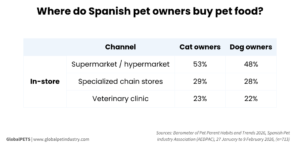
Spanish consumers also show a clear preference for physical retail over online channels when buying pet food. Among dog owners, 86% purchase more in-store than online, most commonly through supermarkets (48%), specialized chains (28%) and veterinary clinics (22%).
A similar pattern is seen among cat owners, with 86.8% shopping in physical stores more frequently. Supermarkets account for 53% of purchases, followed by specialized chains (22%) and veterinary clinics (23%).
Online and omnichannel
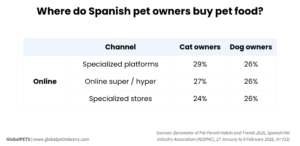
Online-only purchasing remains minimal, with just 1% of dog owners and less than 1% of cat owners relying solely on e-commerce. Among those using digital channels, dog owners spread purchases evenly across specialized platforms, online supermarkets/hypermarkets and specialist retailers (26% each).
Cat owners follow a comparable pattern, with a slight preference for specialized platforms (29%), followed by online supermarkets/hypermarkets (27%) and specialist retailers (24%).
According to AEDPAC, nearly 9 in 10 pet parents now combine channels, confirming that omnichannel has become a standard in the country. “Consumers compare, switch and choose based on convenience. The hybrid experience is no longer a trend – it is the new normal,” it says.
Services
Regarding services, health remains the top priority, ahead of grooming and daycare. More than 9 in 10 dog and cat owners in Spain report regular veterinary visits, while nearly 7 in 10 dogs and about half of cats receive grooming and washing services.
By comparison, daycare and boarding are far less common, with 68.5% of dog owners and 73% of cat owners not using these services.
Budget
Average monthly spending reaches €163 ($176) for dogs and €144 ($155) for cats, with food accounting for the largest share.
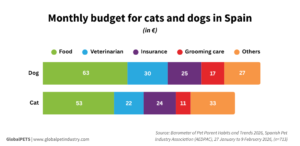
Veterinary care accounts for 19% of dog owners’ budgets, averaging €30 ($32) per month, compared to 15% for cat owners, at €22 ($24) per month. Grooming costs are lower, at 11% (€17/$18) for dogs and 8% (€11/$12) for cats.
Additional expenses – including hygiene products, toys, accessories and gifts – amount to €27 ($29) per month for dog owners and €33 ($36) for cat owners.
Insurance uptake is also increasing, with premiums of €25 ($27) per month for dogs and €24 ($26) for cats. According to AEDPAC, these figures are higher than in previous years, reflecting greater formalization and adaptation to new requirements.
Share this story:
One click prioritizes GlobalPETS in your search results and AI answers.