Cross-border e-commerce broadens pet trade horizons
New fulfillment partnerships and infrastructure investments are reshaping the global pet industry, helping businesses overcome barriers to wider expansion.
As online marketplaces push to grow their reach and logistics networks get more sophisticated, the pet industry is becoming increasingly borderless. Although global e-commerce is creating new and exciting opportunities for pet companies, brands must still navigate regulatory complexity and fulfillment challenges, as well as local variations in consumer trends.
300% revenue growth
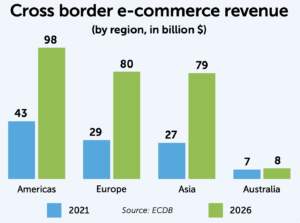
From a worldwide perspective, cross-border e-commerce revenue has tripled in just five years, according to market research platform E-commerce Database (ECDB). The figures indicate that cross- border trade is becoming a structural growth driver for online retail globally, with regional gaps having closed in that time.
The Americas are still dominant in overall value, having gone from $43 billion (€37B) sales in 2021 to $98 billion (€84B) in 2026. ECDB attributes this growth to the success of the major players there, such as Amazon (especially in North America) and Mercado Libre in Latin America.
Meanwhile, Asia demonstrates the biggest revenue growth: 193% in five years, reaching $79 billion (€68B) in 2026. “This surge is powered by a mix of regional e-commerce platforms such as Shopee and Lazada, alongside Chinese giants like Pinduoduo and Alibaba,” ECDB says.
Zooming in on Europe
Cross-border e-commerce is not only accelerating across the Americas and Asia, but also increasing in Europe. The region posted the second-highest growth rate (+176%) and the second-largest cross-border revenue, at $80 billion (€69B). Strikingly, small and medium-sized enterprises (SMEs) in the EU sold more than €40 billion ($47B) on Amazon alone in 2025, setting a record for SME revenue on the marketplace.
According to Amazon, almost half of that – €17 billion ($19B) – came from cross-border exports, representing a year-on-year (YoY) increase of 13%. Intra-EU exports grew at a similar rate, by 12.5% YoY, to €13.5 billion ($16B).
The positive figures from Amazon indicate that the rise of cross-border commerce is reshaping opportunities for smaller businesses in Europe, with marketplaces becoming a key gateway to international customers.
Western markets remain the primary focus for most brands in Europe. Friedrich Schwandt, CEO of ECDB, states that Germany, France, the Netherlands and the UK continue to attract the most attention as they benefit from mature e-commerce ecosystems and strong consumer spending on pets.
However, brands are increasingly looking beyond the region’s largest markets. “Southern and Eastern European markets are more on the radar, particularly for brands that have already established a foothold in the core markets,” he says. Schwandt adds that once a company has built the infrastructure for cross-border trade, the marginal cost of adding a market drops “considerably”.
Streamlining UK-EU trade
Ian Walker, founder and CEO of UK-based company 3P Logistics, has noticed a growing interest from pet businesses in international e-commerce, mainly between the UK and the EU. “We’re working with several pet brands to increase their reach through cross-border and through-channel extensions,” he tells PETS International.
According to Walker, pet companies are seeing higher volumes in both one-off consumer purchases and recurring weekly or monthly subscription orders. In recent years, the company has helped pet gear producer DOG Copenhagen and German manufacturer TRIXIE Pet Products to establish fulfillment operations in the UK, enabling next-day delivery.
In his view, the biggest challenges to scaling international operations still involve the complexities of duties, taxes, customs delays and currency exchanges. Therefore, he is hoping that legal simplification, such as the EU Customs Union reform, will streamline trade and stimulate more companies to participate in cross- border e-commerce.
Building bridges between Europe and China
The growth of cross-border e-commerce is reshaping the way companies approach expansion, logistics and market access beyond Europe, too. This is resulting in new strategic partnerships.
Earlier this year, for example, German logistics company DHL Group and JD.com – one of China’s largest online retailers – signed a Memorandum of Understanding (MoU). The move happened after JD launched its European online retail platform Joybuy in the UK, Germany, France, the Netherlands, Belgium and Luxembourg.
The idea behind the partnership is to collaborate on innovative logistics and e-commerce initiatives, aiming to create integrated solutions and support growth in both China and Europe. DHL and JD’s logistics arm aims to offer fulfillment services and help companies benefit from preferential customs duties and VAT schemes for business-to-consumer (B2C) shipments. DHL says that the initiative will also help German pet suppliers who are looking to expand into the Chinese market.
Supporting German brands
Last May, JD’s cross-border program welcomed German retailer Müller Holding as a member. Müller operates more than 900 stores across Europe, offering a wide range of products spanning beauty, health, household goods, stationery, toys and pet care.
Through the partnership, Müller established a presence in JD’s duty-free shop in Hainan, southern China. Meanwhile, JD provides the logistics and service infrastructure needed to sell Müller’s products in China through both online and offline channels.
Rethinking opportunities in China
Other recent moves by major international companies in China itself suggest a shift in approach. Rather than competing directly with local players, global businesses are increasingly focusing on enabling cross-border trade and supporting sellers.
For instance, after a seven-year absence from China’s online marketplace sector, Amazon returned to the country with a different strategy. Instead of resuming direct sales to Chinese consumers, the company launched warehousing and distribution services aimed at helping local businesses expand internationally.
Since April, Chinese sellers looking to reach overseas markets (particularly the US) have been able to store inventory in bulk at Amazon’s Global Warehousing & Distribution (GWD) facility in Shenzhen, southeastern China. When ordered, the products are then sent to the company’s US fulfillment network.
Strengthening LatAm trade corridors
In a similar move, Latin America’s leading e-commerce player Mercado Libre opened its first fulfillment center in China last December. The online retailer is already utilizing it to ship to its major international markets, including Argentina, Brazil and Mexico.
“We expect the China-LatAm corridor to be an area of incremental growth and investment in 2026 as we scale our fulfilled-from-China model,” the company said in a letter to shareholders. The Uruguay-headquartered company invested further in its cross-border trade business in 2025 to make “it easier for customers to access free shipping, multiple-seller shopping carts and incentives that brought new sellers and selection to the platform”, it added.
In addition to strengthening trade corridors, these investments focus on offering faster deliveries and less costly operations for business partners, to meet the growing demand in digital commerce.
Emphasis on research
To optimally seize the opportunities for international expansion through marketplaces and third-party logistics providers, pet companies would be wise to do their homework. ECDB cites the research phase as an important – but often overlooked – step, highlighting the importance of understanding the actual market structure and how segments are performing in each country.
“Brands that enter a new market without that kind of category-level visibility often position themselves against the wrong trend,” Schwandt says. A local strategy for product compliance, pricing and positioning complements the key areas of focus for businesses seeking to capitalize on this rising market, he concludes.
Share this story:
One click prioritizes GlobalPETS in your search results and AI answers.