How will new EU rules reshape the business environment?

Updated merger guidelines and regulatory changes aim to attract investment and reduce complexity, but their practical effectiveness remains uncertain.
Earlier this year, the European Union introduced measures for simplification and single market integration, and reviewed merger rules that may have significant implications for industry consolidation. The revised legislation should improve the region’s global competitiveness and make it more attractive for businesses.
Theories of harm and benefit
In April 2026, the European Commission (EC) published a draft of its new Merger Guidelines for public consultation, proposing to replace the existing 2004 Horizontal Merger Guidelines and 2008 Non- Horizontal Merger Guidelines. The document places greater emphasis on assessing merger harm through market power, based on criteria such as market shares, concentration levels, profit margins and price sensitivity.
The document identifies several key threats to competition, including reduced direct rivalry, diminished innovation, lower investment incentives and limited access to commercially sensitive information. As a counterbalance to the theory of harm, the guidelines also introduce the theory of benefit. They encourage companies to collect evidence demonstrating potential efficiencies and benefits for consumers.
The draft guidelines outline that under the theory of benefit, a merger can allow firms to profitably lower prices, boost output and innovation, or drive higher investment across multiple markets and geographies. Public consultation closed on 26 June 2026, and the EC is expected to finalize the review process in the last quarter of this year.
Key points of difference
An analysis by global law firm White & Case concludes that the “core analytical architecture” of the Merger Guidelines is preserved. “But it is embedded within a considerably broader and more flexible framework that gives the Commission more tools, more theories of harm to work with, and a more explicit mandate to weigh benefits alongside harms.”
Nicholas Hirst, Chief Correspondent, EU Competition at market intelligence firm MLex, considers the “long section” detailing how deals can negatively affect competition one of the biggest changes. This includes risks such as entrenching dominant positions or combining different products in ways that may create cumulative effects and harm customers.
He also highlights the fact that, beyond the benefits for companies and consumers, the EC will assess how mergers contribute to the “wider European project” by supporting innovation, investment, and the resilience of companies and supply chains across the region.
Assessing market impact
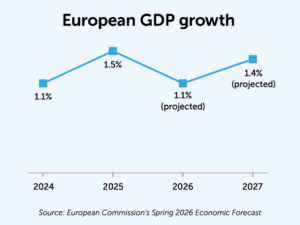
For Gerardo Proaño, Managing Director and Head of Competition at FTI Consulting in Brussels, there is a duality to this proposition. On the one hand, the EU is struggling to grow its economy and the merger law and single market integration can attract more investments. Europe’s GDP expanded by 1.1% in 2024 and 1.5% in 2025, but the Commission’s Spring 2026 Economic Forecast projects growth slowing to 1.1% in 2026.
On the other hand, the EU needs to find ways to prevent excessive concentration. And although investors expect relaxation regarding critical assets, they’re still cautious about targeting European companies. Proaño sees digital and defense sectors as the most likely to have a surge in deals. But he also points to the fact that there is some movement among manufacturers. Beyond sectors, he expects more smaller national consolidations in member states.
Since the beginning of the year, the EC has cleared transactions across diverse industries, such as food and component manufacturing, media and digital infrastructure. This involved cross-continental, intra-EU and national transactions. Most deals were approved unconditionally, although a few required remedies and divestments.
The Simplification Omnibus bundle
The EC has also proposed a Simplification Omnibus package, aimed at creating “simpler, clearer and better enforced EU rules”. To achieve this, it identified five priority areas. These include simplifying legislation by providing greater clarity on compliance requirements and the consequences of non- compliance; improving the regulatory system through greater transparency, stakeholder engagement and efficiency; and launching an action plan to address inconsistencies, overlaps and “overly complex provisions” in existing regulations.
The remaining two areas focus on helping member states to identify national barriers to the single market that go beyond those established in EU law, as well as ensuring faster and more rigorous enforcement, with a focus on reducing the number of longstanding infringement proceedings.
“Outdated, excessive or overlapping laws must be detected and corrected. New proposals need to be more focused, implementable and enforceable. This is simplification in practice,” says Valdis Dombrovskis, Commissioner for Economy and Productivity, and for Implementation and Simplification, at the EC.
A stronger single market
Pet industry players are among those closely following these developments, given their potential impact on companies operating in the European market.
In June, Paolo Rigamonti, Regional President Europe Pet Nutrition at Mars, participated in a meeting between the American Chamber of Commerce to the European Union (AmCham EU), which represents US-based companies operating in Europe, and representatives from the European Parliament and EC.
According to Rigamonti, the meeting aimed “to reiterate the importance of the EU-US relationship and how the EU needs to maintain momentum behind its very important simplification agenda”. In February, he supported the AmCham EU’s calls to strengthen the single market, saying: “A simpler, more consistent regulatory environment helps businesses invest with confidence and boosts the global competitiveness of the region.”
Harmonization is good for business
Gordon Bonnet, CEO of the German Pet Trade and Industry Association ZZF, believes the pet sector could benefit primarily from greater regulatory consistency due to the sector’s cross-border nature. “Many raw materials are sourced across national borders, while production and distribution often take place in multiple EU countries. As a result, even minor national differences can have a direct impact on costs and efficiency,” he explains.
The association highlights, for example, the EU Packaging and Packaging Waste Regulation, as well as documentation and due diligence requirements across supply chains, such as those introduced by the EU Deforestation Regulation, as key areas where greater harmonization between member states is needed.
Putting commitments into practice
Giacomo Fersini, Head of Economic Policy at Eurochambres, the Association of European Chambers of Commerce and Industry, tells PETS International that while the EC plan addresses the right priorities in principle, the real test is implementation.
“Eurochambres members consistently raise three issues linked to the existing regulatory framework: uncertainty on who must comply with what, a confusing accumulation of overlapping rules and inconsistent application across member states,” he says.
It’s a view shared by Bonnet: “A more integrated single market would promote trade within the EU and foster competition. However, its full potential can only be realized if existing regulatory fragmentation is consistently reduced.” According to Fersini, the EU already has a regulation framework that is “better on paper”, but there’s a “persistent gap” between commitments and delivery in practice.
The EU’s communication so far focuses heavily on the Commission’s procedural steps for drafting new legislation, but provides less detail on how the European Parliament and Council amend proposals during trilogue negotiations – discussions between the three EU institutions to agree on the final legal text. According to Fersini, many of the complexities that businesses face stem from changes introduced at this stage.
Where complexity persists
Beyond the broader question of whether the initiative can reduce regulatory complexity, businesses continue to face specific challenges in how EU rules are developed, implemented and enforced. Eurochambres identifies two specific areas where this is the case: the use of secondary legislation and differences in how EU rules are applied across member states.
The first concerns delegated and implementing acts – the detailed technical rules that complement EU legislation and determine how compliance is achieved in practice. According to Eurochambres, these instruments do not undergo the same level of transparency, stakeholder consultation or impact assessment scrutiny as the main legislative acts.
For pet businesses, this issue is particularly relevant as key technical requirements in areas such as veterinary medicines, food additives and product safety are often established through these secondary instruments, sometimes with limited advance notice for smaller operators, Fersini explains.
The second challenge relates to the capacity of member states to implement EU rules consistently. Eurochambres notes that differences in national resources and approaches can lead to varying interpretations and compliance issues.
“The same EU rule can translate into very different practical burdens, depending on where a business operates,” Fersini concludes.
A clearer and more consistent framework could support investment, cross-border expansion and consolidation, but companies remain cautious about whether simplification efforts will translate into practical improvements.
Share this story:
One click prioritizes GlobalPETS in your search results and AI answers.