2010-2025: US pet ownership shifts after 15 years of steady growth

While ownership continues to grow, APPA reveals how pet parents are reallocating budgets toward essentials and becoming more cost-conscious.
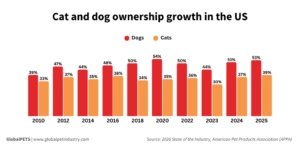
US dog ownership rose from 51% to 53% of households in 2025, according to the American Pet Products Association’s (APPA) 2026 State of the Industry report. This represents 4 million additional households, taking the total to 71 million.
Most of the increase (2.6 million households) was driven by new adopters, with only a minor portion (0.5 million) linked to broader household growth. This suggests the expansion is primarily behavioral rather than demographic.
This is the highest rate of dog ownership since 2020 and the second highest in the past 15 years. In 2010, dogs were present in 4 out of 10 US households, a figure that has steadily grown since then to more than half of American homes.
In 2020, the pandemic led to a surge (54%). Although 2023 showed signs of decline (44%), ownership has continued to rise over the past 2 years, helping solidify the dog’s place in American households.
APPA says that the “expansion is youth-led, but increasingly multi-generational.” This is because, among Gen Z and Millennials, the rate rose 7% YoY, while Gen X owners grew 5% over the period.
Younger owners go for cats
Cat ownership expanded 5% YoY in 2025, as almost 4 in 10 (39%) American households reported owning a cat that year, compared to 37% in 2024. Increased adoption has placed cats in 53 million American homes.
Unlike dogs, cat ownership has fluctuated in recent years, rising from 33% in 2010 to 38% in 2016, then falling to 35% in 2020 and 30% in 2023. This was followed by a strong rebound over the past 2 years, which positions the category as a growth opportunity within the industry.
Furthermore, cat ownership was largely driven by Gen Z owners (+15% YoY), followed by Millennials (+10% YoY).
Considering all species, pets are present in 95 million US households. Freshwater fish can be found in 9 million, reptiles in 6 million, small animals and birds in 5 million, horses in 2 million and saltwater fish in 1 million homes.
Among those, ownership has remained stable for reptiles and horses, while falling for fish, small animals and birds between 2024 and 2025.
Dog and cat spending
APPA data shows that in 2025, cat owners maintained a stable spending breakdown across categories. Pet parents allocated 39% of their budget to products, 29% to food, 28% to veterinary care and 3% to services – unchanged from 2024.
For dog parents, veterinary care remained the largest expense – $31 (€26.49) of every $100 (€85.48) spent, up 1 p.p. in share from 2024. Products (29%) also became more prominent in budgets by roughly 1 p.p., while food expenses decreased by 2 p.p.
Therefore, for every $100 (€85.48) spent on pets, food purchases went from $29 (€24.78) in 2024 to $27 (€23.07) in 2025, “indicating shifts in consumer spending with value-oriented purchasing behavior,” APPA analyzes.
Other animals
For freshwater fish owners, bowls, aquariums and tanks gained even more importance in 2025, accounting for 35% of expenses (up 7 p.p. from 2024). Accessories, on the other hand, decreased from 23% to 15% of the budget.
Reptile owners chose to spend more on food (up 6 p.p.), while sacrificing purchases of toys and medications (down 3 p.p. for both). And for small animals, dollars previously destined to purchasing supplies (down 4 p.p.) were reallocated to veterinary expenses (up 4 p.p.).
For bird owners, expenses on products decreased 4 p.p., while spending on food (up 4 p.p.) and veterinary visits (up 1 p.p.) increased.
For horse parents, veterinary visits – already the top expense – have become even more significant, rising from 36% to 41% of the budget in 1 year.
As a result, trainers and exercisers have dropped to the lowest expense in 2025 (down 7 p.p.), “indicating horse owners are investing less in this area to accommodate other necessities,” APPA explains.
Consumer behavior shifts
Data shows that while the industry’s foundation is solid, with increasing ownership, pet parents are adjusting how they spend on their pets and becoming more cautious about spending overall.
For instance, half of American pet owners didn’t change their spending in 2025 despite economic conditions. At the same time, the share of owners who spent less increased by 10 percentage points, from 22% in 2024 to 32% in 2025. Meanwhile, those who spent more decreased by 15% over the same period, bringing the total to 27%.
“This kind of ‘smart’ or value-seeking spending doesn’t signal a weakening market, but a more intentional one. Products and services that can clearly justify their value are still finding success, while others may be left behind,” the association analyzes.
A positive sign for the industry, however, is that the proportion of owners who say their pet ownership was unaffected by the economy is at a 4-year high, at 82%. These results are based on a survey of 9,221 respondents conducted by APPA in October 2025.
Share this story:
One click prioritizes GlobalPETS in your search results and AI answers.