Australia: cost of caring for pets becoming a major barrier to becoming a pet parent
Despite a record number of pets in Australian homes, rising expenses and financial pressures are affecting both current and future pet owners.
There are more animals than ever in Australia, living in more homes than ever, generating over A$21 billion ($13.9/€11.8) annually.
However, according to the Animal Medicines Australia (AMA), the local pet market has more than just positive news to celebrate: the costs of caring for pets represent the biggest barrier to continued growth in ownership.
The recently launched report Pets in Australia: A national survey of pets and people concludes that pet penetration in Australian houses grew 4 percentage points in the past 3 years.
According to the report, this trend keep increasing: 700,000 households without pets are “actively looking” for a companion animal, and 30% of pet owners (3.2 million households) want to get another one.
AMA’s report reveals that Australia’s pet industry has grown 35% over the past 3 years, with the pet population increasing by 10% over the same period.
The costs involved
However, one third of those who would like to have 1 (or another) pet are worried about their price (36%), the ongoing costs of taking care of them (35%) and the responsibilities involved (30%).
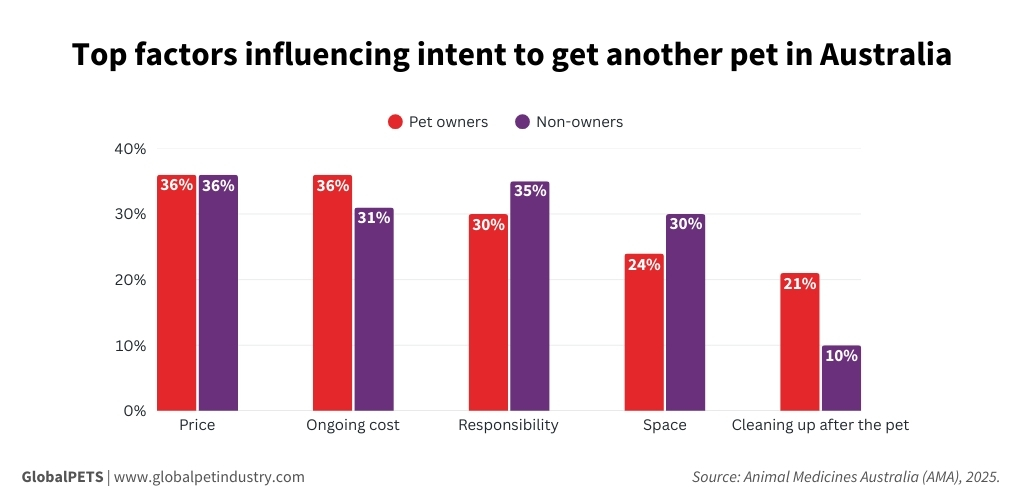
Price and costs significantly affect the decision-making of families with lower incomes and those facing financial vulnerability.
Among pet owners, there was an increase in the number of respondents facing challenges, with 82% reporting at least some difficulty, up from 79% in 2022 and 66% in 2019.
And although in a smaller percentage than wanna-be pet parents, owners are also pointing out costs as a constraint (32%) – a surge from 24% registered in 2022.
Cuts in vet and food
While the overall number of families requiring assistance for their pets’ health was low (12%), the situation is more challenging for specific groups, such as families with children under 18 (18%) and those with higher financial vulnerability (18%).
The impact also led some owners to take their pets to the vet less frequently “because they could not afford the consultation fees or the cost of medicines or procedures,” the report says, and to decrease or delay or skip vaccination due to costs.
18% of cat owners and 14% of dogs “resorted to more extreme health-related sacrifices, including skipping regular check-ups, reducing or stopping medication or giving their pet medication meant for humans,” the AMA highlights.
The food market is also affected, as pet owners have tried to save money or reduce spending mainly by purchasing food at a lower price, buying in bulk or switching to cheaper brands of food.
Share this story: