Chile pet market (I): 3 out of 4 adults have pets, marking a surge from 2024

Dogs remain the most common pet, while spending on health, insurance and services continues to rise.
Pet ownership in Chile has recovered from 66% in 2024 to 75% in 2025. This figure also marks a recovery to pre-pandemic levels, as in 2019, 73% of Chileans reported having a companion animal.
Not only are more Chileans adopting pets, but they are also adopting more pets. The average number of animals per household rose slightly from 2.3 in 2019 to 2.5. The number of homes with 3 or more pets increased from 31% that year to 33% in 2025.
Results come from a survey conducted by Chilean market research and public opinion company Cadem, which interviewed 1,381 adults in August 2025.
Future ownership in check
Despite high levels of pet ownership in the Latin American country, the share of people expecting to become pet parents has dropped sharply from 74% to 48%.
Among the reasons for not adopting, the one that worries respondents the most is lack of space (43%), while the concern that has grown the most since before the pandemic is the high cost of maintaining a pet (22%).
Demographics
Pet ownership is higher in what the survey calls regions (77%) than in the Santiago metropolitan region (70%).
By generation, it is slightly higher among people aged 35-54 (77%), followed by young adults aged 18-34 (76%). Among those over 55, the rate drops to 70%.
The report also shows that younger generations (especially those from 18-34) are boosting the demand for pet-friendly places and activities, such as restaurants, recreational centers and holiday destinations.
Dog domination
Dogs still dominate Chilean households by far: 7 out of 10 respondents report owning one, while only 5 out of 10 own cats. However, the gap is closing, as the difference fell from 37 percentage points (p.p.) to only 19 p.p. during 2019-2025.
Although representing a smaller share, domestic birds saw the largest increase in the period, rising from 3% to 7%. Hamsters and other small rodents correspond to 2%, while turtles, fish and rabbits are owned by 1% or fewer respondents.
Spending and consumption
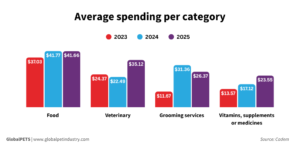
Food is the biggest expense for pet parents in the country, averaging CLP37,600 ($42/€36) per month. Veterinary bills come next, at roughly CLP31,700 ($35/€30).
This is followed by grooming services (CLP23,800/$26.18/€22.70), hygiene products (CLP21,450/$23.60/€20.45), and vitamins, supplements and medicines (CLP21,250/$23.38/€20.25).
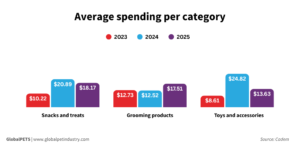
Snacks and treats (CLP16,400/$18.04/€15.65), grooming products (CLP15,800/$17.38/€15.10), and toys and accessories (CLP12,300/$13.53/€11.75) are the categories where pet parents spend the least.
Owners show greater concern for their pets’ health, as the share of respondents willing to pay for veterinary insurance has risen from 41% in 2024 to 55% in 2025.
Pet parents also show a greater willingness to pay for cremation services (55%) and a pet cemetery (38%). “Interest in health insurance and funeral services reveals an emerging market, still underdeveloped in Chile,” says Cadem.
According to data intelligence company Xbrein, the number of pet shops and related services across the South American country has increased by 35% over the past 4 years, rising from 2,500 to almost 3,400 establishments.
Share this story:
One click prioritizes GlobalPETS in your search results and AI answers.