Inflation snapshot: prices accelerate in the US and UK amid energy cost shocks
March data highlights a global uptick in pet supplies, driven by fuel costs linked to geopolitical tensions.
Economic agencies around the world released the first inflation figures reflecting the impact of the conflict in the Middle East. Official statistics broadly attributed the March uptick to rising energy, transport and fuel costs.
In some countries, including the United Kingdom and the United States, pet supply prices have also risen sharply, outpacing inflation in veterinary services and other related sectors.
Europe
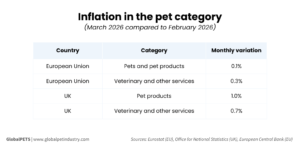
In the European Union, prices of pets and pet products grew modestly by 0.1% month-over- month (MoM) in March, while vet and other pet services saw an inflation rate of 0.3%.
The average consumer price index (CPI) for all items rose 1.3%. Specifically in the Euro Area, Eurostat reports that energy saw the largest annual rate spike in March 2026 (5.1%, compared with -3.1% in February), followed by services (3.2%, compared with 3.4% in February).
UK
In the UK, pet products jumped 1% MoM, a rate 10 times higher than the increase in February (0.1%). This was the biggest increase in 8 months for the category.
Vet services prices increased 0.7% in March. Although more in line with the previous month (0.6%), this was also the largest hike in 9 months.
The overall inflation rate registered in the country was 0.6% MoM, advancing from 0.4% in February. According to the Office for National Statistics (ONS), the largest upward contribution came from energy, whose effect was offset by falling prices on industrial goods.
In 12 months, inflation in the country rose by 3.3%. The Bank of England (BoE) increased its annual forecast for 2026, from 2% before the conflict to a range of 3% to 3.5%.
US
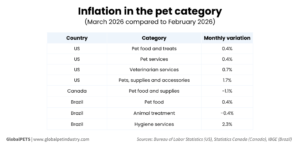
Pet parents in the US faced the highest cost pressure, as prices of pet supplies and accessories jumped 1.7% last month. The rate was almost twice the 0.9% MoM registered in February.
Vet services, on the other hand, eased from a 1.3% increase in February to 0.7% in March.Both services and food/treats posted a 0.4% monthly price increase.
The general CPI rate rose 0.9% in the country, 3 times the February average, and was also pressured by fuel costs. “The index for energy rose 10.9% in March, led by a 21.2% increase in the index for gasoline, which accounted for nearly three-quarters of the monthly all-items increase,” the US Bureau of Labor Statistics (BLS) explains.
“While central bankers typically discount temporary oil supply shocks, a prolonged disruption in the region could have lasting effects on inflation and US economic growth,” says Christopher J. Waller, a member of the Board of Governors of the Federal Reserve. According to Waller, as the US is also exposed to the effects of tariffs and a weaker labor market, it is likely to face a prolonged period of elevated prices.
Canada
In Canada, prices for pet food and supplies fell 1.1% MoM in March, after registering modest growth in February (0.4%). The average CPI rate in the country rose 0.9% MoM and 2.4% YoY, up from 1.8% in February.
Statistics Canada pointed to the same pressure point as the other countries: “Driving faster price growth in headline inflation were higher prices for energy, especially gasoline, due to the conflict in the Middle East. Excluding gasoline, the CPI rose at a slower pace year-over- year in March (+2.2%) compared with February (+2.4%),” it says.
“Moderating the acceleration in energy prices were lower prices for natural gas (-18.1%), which are largely dependent on North American supply and therefore more insulated from global price changes,” it says.
Brazil
In Brazil, hygiene services led the price increase (up 2.3% MoM), followed by pet food (0.4%). Animal treatment, on the other hand, registered a price decline (-0.4%).
Average inflation rate in the country totaled 0.9%, 0.18 percentage points (p.p.) higher than in February. According to the Brazilian Institute of Geography and Statistics (IBGE), “The increase was driven by prices in the transportation and food and beverage groups. Together they accounted for 76% of the month’s CPI.”
Due to the effects of the conflict, the Brazilian Central Bank increased its forecast for annual inflation from 4.71% at the beginning of the month to 4.8% in mid-April. The estimate for 2027 also increased, reaching 3.99%.
General outlook
Authorities’ concerns in various countries about inflation have not yet been reflected in monetary policy. For instance, central banks haven’t (yet) changed interest rates in the US, UK and the EU.
However, the economic effects of the war are expected. In mid-April, the International Monetary Fund (IMF) cut its 2026 global gross domestic product (GDP) growth forecast. “Assuming that the conflict remains limited in duration and scope, global growth is projected to slow to 3.1% in 2026 and 3.2% in 2027,” the IMF says.
The authority also expects global headline inflation to rise modestly in 2026, and resume declining in 2027 if the war ends quickly.
The IMF warns that a longer or broader conflict, alongside rising geopolitical fragmentation, shifting expectations around AI-driven productivity, and renewed trade tensions, could “significantly weaken” global growth and destabilize financial markets.
In addition to the economic impacts, consumer confidence fell in April in the US and hit its lowest level in the UK since 2023, when the country fell into a short recession.
Share this story:
One click prioritizes GlobalPETS in your search results and AI answers.