Market performance (I): US pet industry grows while Brazil stagnates

Growth in pet ownership and essential-care spending is supporting the US market, while services are outperforming products in Brazil.
The pet industries in the US and Brazil continued to expand in 2025, but at markedly different speeds. While the US market benefited from rising pet ownership and continued spending on essential care, Brazil recorded its weakest growth since 2019 amid inflation, exchange-rate pressures and slower consumption.
US pet spending remains resilient
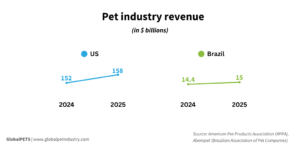
The pet industry in the US registered $158 billion (€137B) in sales in 2025, according to data from the American Pet Products Association (APPA), representing a 3.7% year-over-year (YoY) increase. The rate is stronger than the 3.4% increase from 2024.
Furthermore, the association expects revenue to reach $165 billion (€143B) in 2026, for a projected growth rate of about 4.4%.
The association also released ownership and spending figures from its latest National Pet Owners Survey, which showed that about half of owners report unchanged spending compared with 2024.
However, 22% of pet owners spent less in 2025, an increase of 10 percentage points from 2024, pointing to strengthening value-seeking behavior.
“Significantly more Gen Z and millennials reported that the economy did not affect their pet ownership, and owners’ share of wallet across multiple species shows shifts away from discretionary items toward essential care,” says APPA.
Pet ownership drives results
Dog ownership is on the rise: 71 million US households reported having a dog last year, representing 53% of total versus 51% the year previous. This translates to about 4 million additional dog-owning households YoY. Cat ownership also grew by 5%, with 53 million US households, or 39%, reporting that they owned a cat.
“Growth remains steady, ownership is expanding across multiple generations, and consumers are becoming more intentional with how they spend, prioritizing essential care while still investing in their pets’ wellbeing. That combination creates a strong foundation for the year ahead,” says APPA President and CEO Pete Scott.
Brazil’s growth driven by services
In Brazil, the pet sector grew 3.45%, reaching R$77.96 billion ($15B/€13B) in 2025, according to Abempet (the Brazilian Association of Pet Companies). Results were driven by stronger increases in services (6.8%) than product sales (3.9%).
“With the worst index since 2019, the result reflects the economic and tax scenario and falls short of what Abempet had projected at the beginning of last year,” the association says, as it expected the sector to reach at least R$78 billion ($15.2B/€13B).
After growing 9.6% in 2024, the 3.45% figure is seen as stagnation. The organization assesses that inflation, exchange rates and a slowdown in consumption are negatively affecting the sector, mainly due to the dollar’s influence on the price of basic pet food ingredients.
Category performance
Within the sector, sales of processed pet food reached 53.1% of the total. Next are sales of pets by breeders, representing 11% of the market’s revenue.
Veterinary products represent 10.6% of total sales. Veterinary services are the fourth-largest segment, at 10.5%.
Regarding sales channels, small and medium-sized pet shops account for almost half of all retail sales (48.1%), followed by veterinary clinics and hospitals (17.5%) and mega pet store chains (9.6%). E-commerce represented 8.1% of total sales.
“Despite the growing relevance of digital, this more timid growth is a concern. Consumers are more discerning, which reinforces the need for efficient strategies to maintain competitiveness,” states Caio Villela, Abempet’s CEO.
The contrasting performances highlight how local economic conditions are shaping pet market growth. In the US, expanding ownership and a continued focus on essential care are providing a solid foundation for further growth in 2026. In Brazil, meanwhile, stronger service performance offers positive momentum, although subdued consumption and pressure on product prices are likely to remain key challenges for the sector.
Share this story:
One click prioritizes GlobalPETS in your search results and AI answers.