Pet food and packaging: sustainability is no longer optional
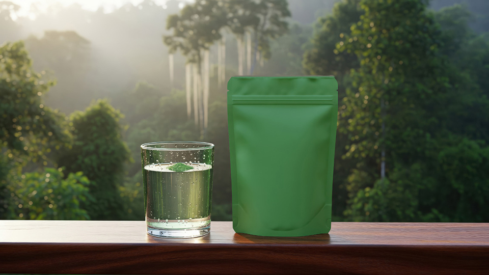
EU packaging legislation is setting new demands for materials, design and production across the pet food sector.
In the past, sustainable packaging in the pet food sector was a strategic choice reserved for brands seeking to appeal to more environmentally conscious consumers. Today, however, it has become an essential standard across the entire market.
Driven by recent European legislation and growing consumer awareness, the entire packaging supply chain is undergoing a genuine sustainability revolution. Manufacturers are being called upon to take prompt, concrete action to develop low-impact solutions that also ensure maximum product protection.
Against this rapidly evolving backdrop, authoritative initiatives have emerged to guide companies towards informed choices. A leading example is RecyClass, the recognised European platform that establishes clear, stringent guidelines for designing highly recyclable packaging that is fully compatible with modern industrial recycling processes.
The challenge is even more complex for pet food packaging due to the following factors:
- Product diversity: requirements vary significantly between dry food, treats, semi-moist food and wet food.
- Extended shelf life: products must remain fresh for longer.
- Supply chain management: various logistical and distribution challenges must be overcome.
- Demanding marketing requirements: packaging must be visually appealing and communicate clearly.
Against this backdrop, adopting sustainable, regulatory-compliant packaging goes far beyond simply meeting legal requirements: it means protecting the future of the planet and strengthening customer trust.
The current European regulatory framework
(EU) Regulation 2025/40
Regulation (EU) 2025/40, known as the Packaging and Packaging Waste Regulation (PPWR), officially entered into force on 11 February 2025. The Regulation aims to significantly reduce the environmental impact of packaging, with a particular focus on the recyclability and sustainability of materials placed on the market:
1. Reduction of packaging waste
The Regulation provides for a progressive reduction in the total volume of packaging placed on the European market by eliminating unnecessary packaging and promoting more efficient solutions.
2. Increased use of reusable and recyclable packaging
The aim is to reduce resource consumption and waste generation by promoting circular models and recyclable materials.
3. Design for recycling
Packaging must be designed to be easily recyclable, using materials that can be readily separated during processing and limiting the use of complex or difficult-to-recycle components.
4. More ambitious recycling targets
The PPWR introduces stricter targets for all packaging materials – plastic, paper, metal and glass – intending to significantly increase recycling rates across Europe.
5. Extended producer responsibility (EPR)
Companies that place packaging on the market are responsible for its entire life cycle, including collection, recycling, waste management and the traceability of the materials used.
6. Promotion of sustainable materials
The Regulation encourages the use of recyclable, low-impact materials, supporting the development of innovative and more environmentally friendly solutions.
7. Transparency and traceability
Manufacturers must provide clear, detailed information on packaging composition, facilitating recycling and ensuring proper management throughout the supply chain.
8. Consumer awareness
Initiatives are planned to raise awareness of recycling and proper waste separation, actively engaging the public in the transition towards a more circular economy.
The PPWR significantly strengthens the principle of ecodesign, encouraging companies to view packaging as an integral part of their sustainability strategy rather than simply as a container. The overall aim is to reduce waste, increase recycling and make the packaging supply chain more sustainable across Europe.
Implementation timeline
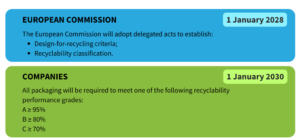
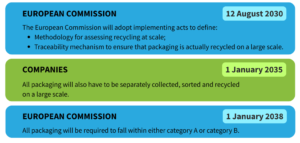
Regulation (EU) 2025/40 will be implemented gradually, with specific deadlines for the various reduction and recycling targets, which each Member State will be required to incorporate into and implement through its national system:
How can a dry pet food bag be made recyclable?
To be effectively processed through the mechanical recycling stream, packaging must meet two fundamental requirements: it must be easy to sort at recycling facilities and preserve the quality of the recycled granules.
While following the guidelines, packaging manufacturers have each developed their own approach to producing recyclable packaging. The real challenge lies in replacing traditional multi-material structures with a single polymer (mono-material) engineered to deliver high mechanical and heat-sealing performance not normally inherent to the material.
Applying this approach to the dry pet food sector, let us explore some practical solutions for achieving maximum recyclability:
Polyethylene-based structure
The most effective mono-material solutions use polyethylene, a polymer that stands out from other plastics for its versatility and extensive scope for customisation.
This material allows thickness, rigidity and transparency levels to be adjusted, making it readily adaptable to different application requirements. Polyethylene has a low specific weight and excellent chemical resistance. Its flexibility, combined with its complete physiological safety – as it is tasteless and odourless – makes it ideal for food packaging.
It also offers excellent impact resistance and good resistance to tearing and puncturing, helping to ensure high performance even under the most demanding conditions of use.
According to the guidelines, the total polyethylene (PE) content must exceed 95% for Class A and 80% for Class B.
Polypropylene- and polyamide-free structure
Many packaging manufacturers offer bags with an outer layer containing between 5% and 25% polypropylene (PP). This technical solution raises the melting point of the outer surface, facilitating sealing during the bag-making process. A similar issue arises with certain closure systems, such as sliders (track-based systems with a sliding tab), for which no solution made entirely from polyethylene (PE) is currently available on the market.
The most authoritative guidelines advocate the use of materials that are completely free from polypropylene and polyamide. Eliminating them enables a higher recyclability class to be achieved: the recycled PE granules are free from contamination, more compatible with existing recycling streams and readily reusable within the circular economy.
Matt exterior finish
The market offers a wide range of matt-finish bags produced using printed silicon-based matt varnishes. This is the simplest process from a technological standpoint, as it applies to polyethylene a technique already widely used with standard materials. In addition to creating the desired aesthetic effect, the varnish also serves the technical purpose of increasing the melting point of the outer layer, thereby facilitating sealing operations. This results in a total ink and varnish content exceeding the limit of 5% of the packaging’s total weight, compromising compliance with the guidelines and hindering effective recyclability.
A more advanced approach, however, has led to the development of an inherently matt printable film, produced through specialised processing of the outer layer. This method not only eliminates the need for surface varnishes but also offers numerous benefits: greater stability, superior scratch resistance, a uniform matt finish and a consistent coefficient of friction throughout the production run, resulting in packaging that delivers better performance, greater reliability and enhanced visual appeal.
Water-based printing
Packaging manufacturers still traditionally rely on solvent-based printing technologies, a potentially polluting method that requires substantial amounts of energy and resources to treat the solvent emissions generated during the process using thermal oxidisers.
A potential solution to these issues has emerged through collaboration between packaging, printing press and ink manufacturers, leading to the development of water-based printing technology for plastic substrates. Although this solution is still evolving and represents a relatively new technological frontier, the results achieved are already outstanding: print resolution of up to 60 lines, an extended colour gamut and halftone screens that are significantly cleaner than those produced using conventional technologies. Beyond its aesthetic quality, the most significant advantage is its reduced environmental impact: water-based printing produces substantially lower volatile organic compound (VOC) emissions than solvent-based printing and uses a highly efficient liquid recovery system, contributing to a more sustainable and responsible process.
The brand owner also plays a key role during the packaging ecodesign stage. During the graphic design stage, it is essential to consider the impact of colour choices: while light colours ensure full compatibility with recycling processes, dark shades offer limited recyclability and should be used only if they can be detected by the near-infrared (NIR) sensors used at sorting facilities. Furthermore, to optimise the entire process, it is essential to minimise ink use by limiting both the total printed surface area and the proportion of ink by weight relative to the packaging as a whole.
Dual composition
Many packaging manufacturers produce mono-material bags by replacing traditional plastics with multiple layers of polyethylene, sometimes resulting in structures comprising three or four layers. In these cases, the adhesive must be applied between multiple layers, significantly increasing its proportion of the packaging’s total weight. This is a critical consideration, as the guidelines impose strict limits, which vary according to the type of adhesive used. For example, full compatibility is achieved when approved adhesives are used at levels below 3%. To overcome these challenges, one possible solution is the DUPLEX mono-material structure, consisting of just two layers of polyethylene bonded together. This optimised configuration significantly reduces the amount of adhesive used, ensuring compliance with the specified limits and improving the product’s overall recyclability.
Absence of extraneous components
Current market offerings include bags designed to enhance marketing communication by incorporating pinch-bottom features and other non-polyethylene components secured with hot-melt adhesives.
Hot-melt adhesive consists of rubber, wax, resin and synthetic polymers. These substances are either incompatible with PE recycling or present in quantities that exceed the limits permitted under the recyclability guidelines.
Priority should be given to fully mono-material solutions, particularly FLAT BOTTOM bags – the most effective option for marketing communication and product presentation – or bags with a QUADRO SEAL base. Both configurations deliver excellent visual results, even for large-format bags and when displayed lying flat, without introducing components that compromise the packaging’s overall recyclability.
Barrier properties
A widely debated issue in the dry pet food sector concerns the protective barrier that packaging must provide to ensure the product’s required shelf life. Ideally, each dry pet food manufacturer should conduct empirical trials using different material structures to assess the condition of the food at the end of the desired shelf-life period. The situation is further complicated by the fact that manufacturers often require bag degassing systems to release air trapped during packaging, either before or during palletisation, preventing the bags from bursting or slipping off the pallet. However, these openings create direct pathways for the exchange of gases and water vapour between the inside and outside of the packaging.
While managing the protective barrier is already complex with traditional packaging, the challenge becomes even greater with mono-material solutions. Given that the conventional metallised barrier – created by depositing aluminium vapour onto a plastic substrate – is excluded under the guidelines because it damages recycling machinery and contaminates the recycled granules, today’s most promising alternatives fall into two categories. On the one hand, there are AlOx and SiOx barriers, which are costly and complex to manage; on the other hand, EVOH may be used provided it does not exceed 5% of the packaging’s total weight.
Reduced material thickness
Pet shops offer a wide range of mono-material bags designed to replace traditional multi-plastic laminates. To achieve the same performance, extremely thick polyethylene layers are often used, easily reaching 190–210 μm (approximately 1.86 g/dm²) in formats above 10 kg. This represents a step backwards compared with a large-format bag featuring a standard matt multi-plastic structure, which has a lower average thickness of 160–170 μm (PET12 + PETMET12 + LDPE140 μm or PP20 + PETMET12 + LDPE140 μm – approximately 1.67 g/dm²). Such an increase in the thickness of new packaging clearly contradicts the “3Rs” principle (Reduce, Reuse, Recycle) enshrined in EU directives, which identify reducing packaging weight as the foremost criterion of genuine sustainability.
The way forward, therefore, is not to compromise but to optimise the technical performance of the raw material in order to minimise thickness. By pursuing this approach, it is now possible to produce large-format bags just 170 μm thick (approximately 1.58 g/dm²), fully in line with traditional standards but with the major advantage of a mono-material structure. The result of this innovation is both tangible and environmentally beneficial, delivering a real and immediate reduction in both the amount of plastic placed on the market and the overall volume of post-consumer waste.
Mechanical resistance
The drop test is a mechanical test in which a bag is dropped from a height of 1.5 metres in an upright position to assess its impact resistance. Bags with a standard structure generally perform poorly in this test, and mono-material solutions typically offer no significant improvement.
By contrast, some companies have taken the opportunity presented by product re-engineering to address this critical issue as well. By making targeted use of polyethylene’s elastic properties, the new bags are extremely impact-resistant and do not rupture even after numerous consecutive drops.
This feature provides significant added value: customers can have greater confidence during warehouse picking, logistics operations and in-store handling, knowing that the contents of the bag will remain protected and intact even if it is accidentally dropped.
Conclusions
The PPWR places a clear responsibility on us: to design packaging that minimises post-consumer waste and can be easily recycled into high-quality secondary raw materials.
Plastic is indeed an organic material that degrades, but we have the technology and expertise to slow this process. After all, plastic remains irreplaceable in the food and pet food sectors: it provides lightweight packaging, maximum food-contact safety and excellent visual appeal. As oil is a finite resource, it is our duty to use it where it provides real value and genuinely makes a difference. The same principle applies to bio-based polymers.
The key to the future is cooperation throughout the entire supply chain. Pet food manufacturers, packaging machinery manufacturers and packaging producers must join forces to design genuinely recyclable solutions. Protecting market share is a priority for everyone, but true competitiveness today depends on adherence to shared rules, transparency and the ability to look beyond individual business interests for the benefit of the sector as a whole.
Share this story:
One click prioritizes GlobalPETS in your search results and AI answers.