Pet food e-commerce triples in Latin America as digital adoption reshapes the market

Online penetration rises steadily across the region, with Argentina leading adoption at 11.4%.
Latin America has shifted more intensely from homemade to industrialized food as the basis of pet nutrition. Data from Worldpanel by Numerator provided to GlobalPETS shows that pet products grew more in market share – 6% year-over-year (YoY) in 2025 – than basic food items, which increased 4% YoY in the same year.
Despite all channels registering good sales figures, e-commerce growth has been nearly exponential. In the last 3 years, online pet food sales more than tripled in value, rising from $25 million (€21M) in the first quarter of 2023 to $82 million (€70M) at the end of 2025.
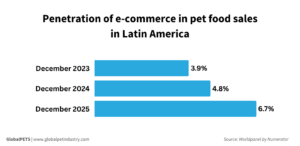
During the same period, e-commerce penetration in pet food purchases jumped over 60% in the region, rising from 3.9% in December 2023 to 4.8% in December 2024 and 6.7% in the same month of 2025.
According to Worldpanel by Numerator, snacks and wet dog food are experiencing significant growth, although dry food remains the most relevant category.
“Beyond this, e-commerce is developing a lot in the region, not only for pet food, but also for FMCG in general. So, it’s something that accompanies a structural change in the market that pet food is taking better advantage of,” says Nacira Barraza, Account Manager for Latam.
Across all channels, pet food increased its share of total fast-moving consumer goods (FMCG) spending by 30%, rising from $1 billion (€0.84B) in 2023 to $1.3 billion (€1.1B) in 2025.
Mexico leads the market
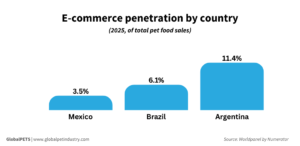
Mexico is the largest pet food consumer market in the region, according to the data. However, it ranks among the least advanced in e-commerce adoption. While the average market share for Latin America was 6.7% last year, it was 3.5% in Mexico.
Even though low, it is slowly advancing, having increased from 1.7% in December 2021 to 2.4% in December 2024. “9 out of 10 Mexican households buy pet food. We see it as significantly underdeveloped in e-commerce penetration, especially for pet food, with a great opportunity for growth,” adds Barraza.
Brazil and Argentina follow
Brazil is the second-largest country in the region in terms of total market, but the largest in absolute e-commerce revenue, with a sales penetration of 6.1%.
According to the expert, this is driven by an increasing number of household buyers of packaged pet food and the growing adoption of digital channels in the country, both in marketplaces and pet specialty retailers.
Despite having a smaller overall market size, Argentina has the most developed pet food e-commerce sector, with an 11.4% share of total sales. According to Worldpanel by Numerator, it is a highly developed country in e-commerce beyond pet food.
The largest countries by market value in the region, Chile and Colombia, are also seeing accelerated adoption of online shopping.
Growth outlook
Online sales are expected to continue outperforming overall category growth in the coming years, driven by shifts in both spending patterns and demographic trends.
Growth in the pet food category is projected to remain positive, with e-commerce expanding at a faster rate than brick-and-mortar retail in percentage terms.
This trend is closely linked to the wider adoption of commercial pet food across the region, alongside broader demographic changes such as declining birth rates and the evolving role of pets within households, reflecting a global shift in pet ownership behavior.
Childless households now represent the largest segment of pet owners, with 43% of people over 65 without children owning a dog or cat, accounting for 16% of the category’s total value share, according to Worldpanel data.
Share this story:
One click prioritizes GlobalPETS in your search results and AI answers.