Pet spending in Australia increases by 35% since 2022, reaching A$21.3 billion in one year
New research from Animal Medicines Australia (AMA) reveals that food still accounts for almost half of owners’ spending.
According to a new industry report by the Animal Medicines Australia (AMA), the pet industry in the country grew 35% in the past 3 years, showing a strong demand for pet-related products and services.
The association estimates that pet spending exceeded A$21.3 billion ($14B/€12B) in the 12 months to March 2025, based on its own research results and data from the Australian Bureau of Statistics. “This represents a significant increase in spending compared to the revised 2022 expenditure total of $15.7 billion ($10.4B/€8.8B),” AMA highlights.
The food segment accounts for the largest share of spending, by far. In the 12 months ending in March, it reached A$9.8 billion ($6.5B/€5.5B) in expenditures (46% of total). This amount is significantly higher than veterinary expenses, which hold the second-largest share at A$1.9 billion ($1.3B/€1.1B).
Products or accessories (A$1.4B/$925M/€786M), pet insurance (A$1B/$661M/€561M), and flea, deworming and tick treatments (A$1B/$661M/€561M) round out the top 5 expenses among Australians. See the totals in the chart below.
The AMA survey was conducted in February and March 2025 and included 2,450 respondents.

Preferred channels
Pet shops remain the preferred channels for pet owners looking for products and accessories, in line with 2022. Clients purchased items in pet shops in person (24%) and online (14%), at the supermarket (22%) and at retail stores (16%).
For food, there are some differences. While the majority of dog and cat owners buy this item in supermarkets, this year saw an increase in demand for pet shops or retail stores. The association attributes this to the entry of new players into the Australian market, such as home and garden retailer Bunnings, which expanded its pet range in 2023.
Dogs account for the largest expenditure
The report shows that dogs dominate the economy in terms of ownership and value. Although they are more populous in the country, they represent almost 49% of the pet population, and the amount their owners spend is significantly higher than for other animals.
According to the AMA report, the average purchase price for dogs is A$1,419 ($925/€795). This makes the initial purchase price high for 75% of dog owners, as only 25% of them receive their pets for free. Cats, on the other hand, are more often acquired for free (47%) and, when purchased, have an average purchase cost of A$419 ($277/€235).
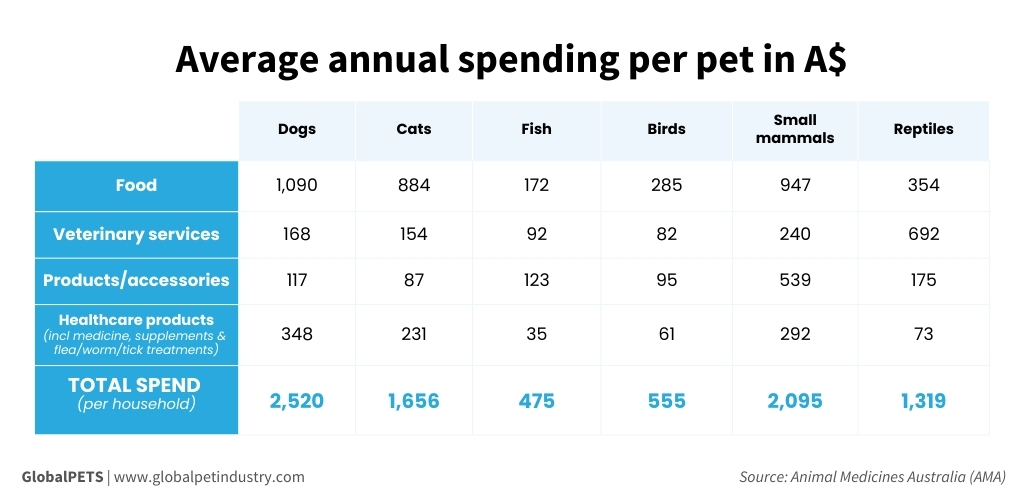
In terms of ongoing expenses, the annual cost of owning a dog averages A$2,520 ($1,643/€1,413). The second most expensive type of pet is small mammals, whose annual expenses average A$2,095 ($1,384/€1,175). For cats, it drops to A$1,656 ($1,094/€929), followed by reptiles (A$1,319/$871/€740), birds (A$555/$367/€311) and fish (A$475/$314/€266). See details below.
Despite the costs, the report shows that owners tend to value the benefits generated by purchases, especially those related to food, more than the price and value for money.
10% surge in population
The survey also showed a 10% growth over 3 years, as the pet population increased from 28.7 million in 2022 to 31.6 million in 2025.
This growth marks the biggest penetration of pets in households in recent years: in 2025, pets are present in 73% of Aussie homes, rising from 69% in 2022, 61% in 2019, and 62% in 2016 – a sign of consistency after the pandemic boom.
Share this story: