UK pet brands missing out on organic search opportunities, report finds

While some brands struggle to win new customers online, those with a balanced approach thrive.
While pet owners are increasingly resorting to online searches to solve daily queries, some brands in the UK still don’t profit from the potential of organic searches.
By analyzing 20 UK pet companies’ performance in online searches in August, London-based pet marketing agency Bubblegum Search found that “while household names enjoy strong brand recognition, they’re failing to capture the fast-growing discovery phase of consumer search when pet owners look for solutions.”
Half of the brands included in the company’s Pet Brand Organic Benchmarking Report 2025 still see more than 50% of their traffic from branded searches.
The most heavily reliant on this type is the pet food producer Barking Heads, with 81.7% of branded traffic, followed by YuMove, producer of joint supplements for dogs (76.2%). The list also includes household names such as Lily’s Kitchen (60.3%) and Royal Canin (56.3%).
Brand awareness
The cause for the dependence, according to Matt Cayless, founder of Bubblegum Search, is an “unbalanced” approach. “Many either go all in on brand awareness, which limits their reach beyond existing customers, or they go too broad without building any brand authority,” he tells GlobalPETS.
According to Cayless, companies that struggle in organic search often have a limited keyword footprint and lack linkable content, both of which weaken their overall authority profile.
On the other hand, the top organic performers also share some common factors: balanced traffic sources, thousands of ranking keywords and consistent link growth.
Among the companies analyzed that depend least on brand traffic, the following stand out: the producer of healthy food, treats and supplements Pooch and Mutt (7.5%), the cat food brand Whiskas (26.5%), the accessories retailer Lords and Labradors (19.8%) and the cat sitting service Cat in a Flat (38.9%).
Nuances by segment
The study sample was roughly two-thirds product-led brands (food, retail, e-commerce), a few supplement and wellness brands and one dedicated to pure service.
“Retail and e-commerce brands like Animed and Lords & Labradors lead the way thanks to large product inventories and a high number of ranking keywords”, the founder states.
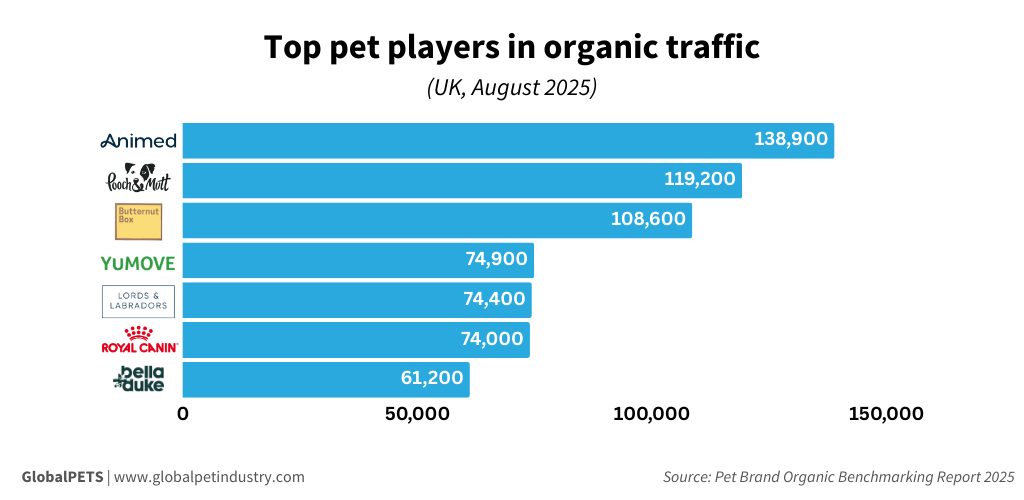
The same result was found in a recent report by marketing agency Herd. In their analysis of 2,500 pet-related keywords in the UK between July 2024 and July 2025, the retailer Pets at Home had the highest visibility, mainly due to “its extensive product ranges.” Their report also showed good performance of Butternut Box and Pooch and Mutt, mainly due to their “brand awareness strategy.”
The supplement brands analyzed by Bubblegum Search had an advantage in specific cases: “when they pair their products with educational content that answers pet-owner health questions,” Cayless explains.
The only service-based brand analyzed, Cat in a Flat, competed through “localized and intent-led search visibility, ranking for terms like ‘cat sitter near me’ or ‘cat sitter London,’” the agency analyses. Beyond the content, the service also relies on reviews to build its online presence and authority.
Playing with AI
The gap becomes even more pronounced in the AI-driven search results, now available in some browsers. “Google’s AI is now surfacing trusted, well-cited sources rather than just whoever’s ranking high for blue links,” Cayless adds.
According to the agency, however, there are strategies to expand AI searches. These include frequently asked questions (FAQs), guides and comparisons and structured formats that the algorithm inserts into its summaries.
Smaller pet players can also stand out in niches by producing expert-led content on specific areas of interest, such as gut health for dogs or sustainable pet food.
Share this story: