US: Pet insurance hits record levels in 2025

The population of insured pets grew by a high-single-digit percentage last year, with dogs continuing to account for the vast majority.
In the US, the pet insurance penetration rate reached 4.3% in 2025, with dogs leading at 6% and cats at 2.3%, according to new data from the North American Pet Health Insurance Association (NAPHIA).
Based on the American Veterinary Medical Association’s (AVMA) estimate of 163.6 million pets in the US last year – comprising 87.3 million dogs and 76.3 million cats – these rates translate to approximately 5.2 million insured dogs and 1.7 million cats, or nearly 7 million pets overall.
This total marks a record high, increasing 9% year-over-year (YoY) and 76% over the past 5 years.

NAPHIA published its State of the Industry Report 2026 on 21 June. The report analyzes data representing the majority of pet health insurance (PHI) providers operating across Canada and the US.
Gross written premiums
In-force gross written premiums (GWP) – the total value of insurance premiums written before deductions such as reinsurance or refunds – also reached a record $5.7 billion (€4.8B).
However, YoY growth slowed to 19.7%, the lowest annual increase recorded in the past 5 years. By comparison, GWP growth peaked at 24.2% in 2022.
According to NAPHIA, in-force GWP has continued to outpace growth in the total number of insured pets because average premiums have risen consistently each year.
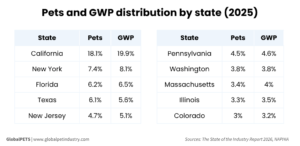
At the state level, California ranked first for both GWP and pet ownership share, accounting for 19.9% and 18.1%, respectively. It was followed by New York (GWP 8.1%; pet ownership 7.4%), Florida (6.5%; 6.2%), Texas (5.6%; 6.1%) and New Jersey (5.1%; 4.7%).
Cats vs. dogs
Dogs continued to dominate the US pet insurance market in 2025, accounting for 84.5% of in-force GWP. Premiums from insured dogs totaled $4.8 billion (€4.1B), while insured cats generated the remaining 15.5%, or $880 million (€748M).
In-force GWP for both dogs and cats reached new highs in 2025. Dog premiums rose 17.6% YoY and have more than doubled since 2021, increasing 109% over the past 5 years.
Cat insurance premiums climbed 33.1% YoY to a record $880 million (€748M) in 2025. Although growth eased from the 39.1% increase recorded in 2022, it remained the second-highest annual growth rate of the past 5 years.
Average annual premiums
Average annual premiums increased across most pet insurance products in 2025, with Insurance with Embedded Wellness recording the strongest YoY growth. In this segment, premiums rose 31.9% to $859 (€730) for cats and 7% to $1,414 (€1,202) for dogs.
For Accident & Illness policies, premiums increased 12.6% YoY to $435 (€370) for cats and 11.5% to $836 (€711) for dogs. Cat premiums fluctuated between $370 (€315) and $386 (€328) from 2021 to 2024 before increasing in 2025, while dog premiums rose steadily from $625 (€531) in 2021.
Accident Only premiums remained relatively stable. Cat premiums edged up 1.4% YoY to $112 (€95), while dog premiums declined 1.6% to $190 (€162).
Most common claims
According to the report, gastrointestinal (GI) conditions were the most common claims for both dogs and cats across the US and Canada in 2025.
Other leading claims for dogs included otitis (ear infections), skin conditions (including infections, masses and dermatitis), anxiety, behavioral and neurological conditions, and allergies.
For cats, the most common claims after GI conditions were dental disease, urinary tract infections, anxiety, behavioral and neurological conditions, and respiratory conditions.
The largest claim paid for a dog was $66,600 (€56,610) for treatment of a chronic undiagnosed illness involving a 3-year-old Bernese Mountain Dog in Philadelphia.
For cats, it was $51,600 (€43,860) for cancer treatment for a 4-year-old American Shorthair in Los Angeles, California.
Share this story:
One click prioritizes GlobalPETS in your search results and AI answers.