US pet insurance tops $1.5B in quarterly premiums. Is competition heating up?

Penetration remains low despite strong growth, leaving insurers with significant room to expand. GlobalPETS has the details.
The US pet insurance market continued its double-digit growth trajectory in the first quarter of 2026, with direct premiums written reaching an all-time quarterly high of $1.53 billion (€1.32B), according to financial and market data provider S&P Global Market Intelligence.
The figure was 16.8% higher than the $1.31 billion (€1.13B) recorded in Q1 2025 and also exceeded the $1.47 billion (€1.27B) reported in the final quarter of 2025.
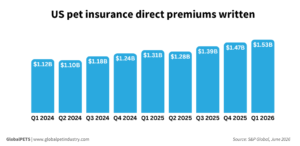
S&P’s analysis of annual data found that US pet insurance has recorded double-digit growth every year since at least 2018. However, the pace has moderated from the exceptional growth seen earlier in the period. Net premiums earned increased 26.6% in 2024 to $3.2 billion (€2.8B), before growing a further 11% in 2025 to a record $3.6 billion (€3.1B).
The American Veterinary Medical Association (AVMA) estimates that around 5.2 million dogs and 1.7 million cats in the US are insured.
Competitive landscape shifts
Trupanion remained the largest US pet insurance underwriter between January and March 2026, recording $335.5 million (€290.5M) in direct premiums written, up 11.1% year over year from $302 million (€261.6M).
However, the most notable change among the leading players was JAB Holdings’ performance.
The S&P research shows that the company’s direct premiums rose 50.2% year over year to $282.5 million (€244.6M), making it the second-largest pet insurance group by direct premiums written during the quarter. In Q1 2025, the company ranked third with $188.1 million (€162.9M).
Nationwide Insurance moved into third place in Q1 2026, with $238.8 million (€206.8M) in direct premiums. Unlike most of its leading competitors, however, the insurer recorded an 11.9% year-over-year decline. Nationwide had also reported a 2.2% decline in Q1 2025, indicating that its market position may be facing pressure.
The shift is also visible in the full-year figures. Trupanion remained the leading US pet insurer in 2025, with $1.22 billion (€1.06B), while Nationwide saw its premiums decline by 6.4% to $956.3 million (€829M).
Loss ratios improve
The industry’s average direct incurred loss ratio fell to 66.8% in Q1 2026, compared with 71.6% a year earlier. A lower loss ratio means that insurers are paying out a smaller proportion of premiums in claims, potentially supporting improved underwriting profitability.
This follows a more modest full-year improvement, with the industry’s net loss ratio declining from 76.1% in 2024 to 74.2% in 2025, according to S&P.
Among the leading insurers in Q1 2026, JAB Holdings, MS&AD Insurance Group Holdings, Lemonade and Nationwide reported direct incurred loss ratios between 61% and 65%.
MetLife recorded the highest ratio at 81.6%, followed by Fairfax Financial (80.5%), Chubb (75.3%) and Trupanion (72.1%).
Market outlook
Despite the market’s expansion, S&P’s latest analysis suggests that pet insurance remains far from mainstream among US pet owners.
This combination of low penetration, rising veterinary costs and increasingly sophisticated veterinary care could continue to support demand for pet insurance.
At the same time, the changing positions of major players suggest that the next phase of market growth may be accompanied by increasing competition among insurers, S&P concludes.
The pet insurance penetration rate in the US reached 4.3% in 2025, with dogs leading at 6% and cats at 2.3%, according to NAPHIA.
Share this story:
One click prioritizes GlobalPETS in your search results and AI answers.