Analysis: Greencross deal setback reflects Australia’s cautious M&A climate
GlobalPETS research shows a more selective capital market in the country, despite more IPOs and smaller valuations.
In July, Australian retail chain Coles announced it was in talks to acquire pet retailer and veterinary chain operator Greencross Pet Wellness for A$4 billion ($2.9B/€2.4B). Less than a month later, the giant said it had ended talks with Greencross’ owner, TPG Capital.
In a short statement, Coles said only that it “applies a disciplined approach to acquisitions, and as one of Australia’s leading retailers, regularly assesses strategic opportunities that may complement its existing business.”
After the first announcement, Coles shares dropped more than 4% but jumped 5% when the company informed the market that negotiations had ended.
“Greencross valuation appears above the odds on most metrics that have been mentioned publicly, with Coles walking away from the deal after doing due diligence,” explains Antony Lynch, Managing Director at Tractus M&A Partners, an investment firm based in Melbourne.
Potential IPO
A$4 billion ($2.8B/€2.4B) is the valuation TPG Capital was reportedly expecting from an initial public offering (IPO) that has been speculated in the country’s media since January.
But only one company that entered the Australian Securities Exchange (ASX) in 2026 has a valuation at this level: Pan African Resources, a gold producer that also trades in the UK and South Africa.
“TPG’s pricing appears to leave little on the table for investors in an IPO. Greencross is also exposed to consumer spending, which has weakened considerably, and so the backdrop is not positive for getting the IPO away in the current market. There is additionally always an element of caution in taking IPOs from private capital,” Lynch tells GlobalPETS.
Selective market
The uneasy feeling of stagnation after the failed deal and IPO is not unique to the pet sector. The Australian market has been “fairly limited and selective,” especially in the last calendar year.
“There have been smaller mining ‘punting’ IPO issues, generally sub A$100 million ($70.7M/€61.2M) market capitalization,” Lynch comments.
According to the Managing Director, the main listings in the industrial space involve Koala, a high-end mattress producer that has the sixth highest market value among the newcomers; SkinKandy, a body-piercing chain that raised A$160 million ($113M/€97.7M) in May; and the construction company FDC, which has a strong specialization in data warehouse construction and raised A$400 million ($282.7M/€244.8M) in June.
More listings, smaller companies
Data from the Australian Securities Exchange (ASX) shows that although 2026 had more listings in the first 7 months than 2025 (29 this year versus 16 the year before), the average market cap of listed companies was less than half that of one year ago.
In 2026, the average market cap of companies that completed an IPO is A$350.7 million ($247.8M/€214.7M), compared to A$896.9 million ($633.7M/€549M) in 2025. Last year had already declined from A$1.4 billion ($1B/€877M) in 2024.
In terms of numbers, the market has begun to recover. It averaged 45 IPOs per year between 2013 and 2016, then rose to 64 between 2017 and 2020, and peaked at 178 in 2021.
An average of 33 companies per year entered the stock market in 2023 and 2024, then returned to 46 in 2025.
At least 8 companies have applied to the ASX, demonstrating their intention to list over the next 4 to 6 weeks (August and September): 7 in exploration and mining and one provider of AI computer infrastructure and cloud platform services.
M&As
A report from Pitcher Partners, a network of independent accounting and advisory firms, recorded a contrasting trend for mergers and acquisitions. In the first half of 2026, while deal volume dropped 14% to 470, value rose 25% to A$88.5 billion ($62.5B/€54.1B).
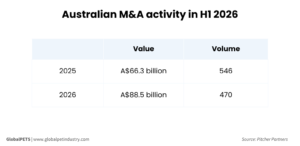
The research concludes that half of the acquirers are international, with particular interest in mining and oil and gas (the sector represented 5 of the 10 largest deals in the period).
On the other hand, mid-market deals (involving mid-sized companies) decreased in both value (6%) and number (4%).
Capital raising
The Australian market is closely following Firmus, an artificial intelligence infrastructure company, which announced at the beginning of August that “it has received commitments for a $2 billion (€1.7 B) strategic equity investment round” with participation from AI computing firm NVIDIA, and new investment from funds managed by asset management firm Blackstone.
According to Antony Lynch from Tractus M&A Partners, the company is expected to launch an IPO “sometime in the next 12 months,” as it reported a post-money valuation above A$10.5 billion ($7.4B/€6.4B).
This example illustrates a broader reality: AI has dominated capital raisings over the last 12 months. “Data warehouses are the ‘thematic’ route that domestic investors have used as a ‘proxy’ to gain exposure to the growth of AI,” the Director explains.
Selective M&A activity
In the ASX data, materials is the industry group dominating the IPOs this year, followed by energy, capital goods, consumer discretionary distribution and retail, software and services, and health care equipment and services.
Data on M&A deals completed in 2025 points in the same direction, with deals peaking in energy, mining and utilities; technology, media and telecommunications; and Pharma, medical and biotech.
“So, while the market activity has been slower relative to ‘bull market’ conditions, there has been corporate raising activity, but this has been selective in sectors and/or at the valuations on offer,” Lynch concludes.
Share this story:
One click prioritizes GlobalPETS in your search results and AI answers.