Pet industry pulse (II): Manufacturers deliver growth despite uneven market conditions
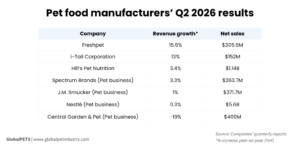
Six of seven companies analyzed by GlobalPETS increased sales in Q2 2026, with a favorable price-volume mix and channel expansion offsetting market and cost pressures.
Pet food manufacturers largely mirrored retailers in the sector, where 100% of the retailers analyzed posted revenue growth in the second quarter. Among a sample of 7 publicly traded companies, 6 posted growth, while 1 experienced a sharp decline.
However, this broad positive landscape is not uniform; it encompasses growth rates ranging from 0.3% to 15.5%, driven by equally uneven factors, strategies and market conditions.
Certain growth drivers benefited multiple companies, such as favorable price-volume mix, rising demand for cat food and general treats, market share gains for premium and diet options, and channel expansion, whether through an e-commerce uptick or increased store penetration.
How companies handled tariffs, one-off investments or divestitures, and spending also weighed on operating and net profits, metrics that, overall, showed a more mixed trajectory during the quarter.
To conduct this analysis, GlobalPETS considered the latest results released by the selected companies, covering a period roughly equivalent to the second quarter of calendar year 2026. Some reported periods may vary depending on how companies structure their fiscal years and quarters.
Strong rise
Fresh dog food producer Freshpet led net sales growth in the quarter, with a 15.5% year-over-year (YoY) jump to $305.6 million (€269M) in revenue. The company attributed this mainly to sales volume, driven by higher household penetration (+5% YoY), increased customer buying rates and expanded channel penetration.
Thai pet food manufacturer i-Tail Corporation also posted a strong 13% YoY uptick in net sales, with $152 million (€134M) in revenue for the period. At the company, the story was different: cat food drove the results, especially functional and health-oriented formulations. Pet treats also remained the fastest-growing segment within the company.
Both companies also posted a solid increase in profit, with net income jumping 19% at Freshpet and 21.3% at i-Tail, and both attributed the performance to one-off payments. The US-based manufacturer received an equity investment from a previous divestiture, while the Thai-based producer reported tariff refunds.
Good results
A new pair of companies posted similar results, though well below those of the companies mentioned earlier.
Hill’s Pet Nutrition, the pet food division of Colgate-Palmolive, posted a 3.4% YoY increase in net sales to $1.2 billion (€1B), helped by strong e-commerce performance and omnichannel activations for its premium offering, Hill’s Prescription Diet. The company registered widespread revenue gains, except for Science Diet dog, which CEO Noel Wallace attributed to a shift in dog ownership from larger to smaller breeds.
Spectrum Brands’ Global Pet Care (GPC) division followed very closely, with a 3.3% yearly rise in net sales to $263.7 million (€232.1M). The manufacturer attributed the improvement to pricing and favorable product mix, highlighting market share gains in chews, stain and odor products, grooming and aquatics.
But CEO David Maura also said the redesign of price-pack architecture, which organizes the portfolio into ‘good, better, best’ tiers, is helping retailers gain more clarity in shelf organization and pricing.
On profitability, it’s hard to draw a parallel since the companies released different metrics. While Hill’s posted an operating profit of 2% for the quarter, Spectrum Brands reported only its adjusted earnings before interest, taxes, depreciation, and amortization (EBITDA), which jumped 91.8% in the period.
Modest numbers
The J.M. Smucker Company’s US retail pet food segment also expanded, but more modestly. Revenue grew 1% during the quarter, hitting $371.7 million (€319.7M). Like Spectrum Brands, favorable volume/mix was a growth driver. Other levers were cat food sales, similar to i-Tail, and soft and chewy snacks, which rose by double digits.
Nestlé’s pet care sales increased marginally by 0.3% to $5.6 billion (€4.9B), boosted by continued strength in cat food and improved performance in dog food, as well as a contribution from price.
The flattish result reflects challenges and opportunities in regional markets. In the US, for example, growth was impacted by “retailer inventory reduction,” according to the company, while Europe registered increases in premium wet cat and “strong performance” in e-commerce.
Once again, comparing profitability is difficult. J.M. Smucker’s segment profit declined 2% in the quarter due to higher costs and increased marketing spending. Nestlé, meanwhile, released only the segment’s underlying trading operating profit (UTOP) for the first half of the year, which fell 4.6%.
Net sales decline
American manufacturer Central Garden & Pet was the outlier. The company’s pet portfolio posted a 19% YoY decline in net sales to $400 million (€352M), driven by its exit from the pet distribution business at the start of the quarter. According to CEO Niko Lahanas, the divestiture will continue to reduce reported revenue over the coming quarters.
However, organic net sales increased 2% YoY to $380 million (€334M) during the period, with broad gains across most of the portfolio, especially in small animals, equine and avian.
The only segment-level profit metric released was adjusted EBITDA, which fell 2.3% during the period and was also affected by the divestment.
What guidance says
Most of the companies only release guidance for their full operations (comprising other segments beyond pet). Overall, 6 of 7 expect performance to increase in the fiscal year.
For net sales growth, expectations range from Spectrum Brands’ forecast of flat to low-single-digit growth, to Colgate-Palmolive’s outlook of 2%-6%, Freshpet’s forecast of 10%-12%, and i-Tail’s 17%-20% expansion in dollars.
Nestlé reported expected organic growth of 3%-4%, while Central Garden & Pet raised its diluted earnings per share guidance by 5.5%. J.M. Smucker is the only manufacturer in this selection that expects net sales to decrease by 1%-2% YoY.
Despite some challenges in the dog segment, manufacturers reported pockets of growth across several animal categories. Both price and volume helped the sector navigate a quarter marked by high inflation and supply chain disruptions.
For more insights:
Pet industry pulse (I): Retailers post growth as expansion and loyalty drive sales
Share this story:
One click prioritizes GlobalPETS in your search results and AI answers.