Inflation snapshot: Pet prices fluctuate as markets face higher interest rates

Pet prices moved in different directions across Europe, the US, Brazil and India in August as central banks adjusted monetary policy.
While prices for pet products and services continue to fluctuate globally, with countries alternating ups and downs in a constant normalization cycle, overall Consumer Price Index (CPI) rates across economies accelerate persistently.
As a consequence, central banks around the world have revised their monetary policies in the past three months, with the vast majority raising interest rates in the US, Europe, Oceania, Asia and South America.
Europe
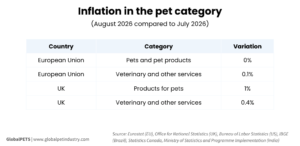
Prices in the European Union remained nearly stable in August, particularly for pet products, with a month-over-month (MoM) CPI of 0% compared to veterinary and other pet-related services (0.1% MoM).
The result narrowed the gap in year-to-date figures between the categories. Year-over-year (YoY), the CPI rate for pets and pet products rose from 0.3% in July to 0.5% in August, while the YoY increase for veterinary and other services went from 3.5% to 3.4% during the same period.
Monthly CPI increase for products was led by Estonia (7.1%), Latvia (3.3%), Lithuania (2.7%) and Luxembourg (2.5%). Estonia and Lithuania also led in services inflation (2.8%), together with Slovakia (2%) and Hungary (1.1%).
Across all items, European Union annual inflation was 3.2% in August, up from 3% in July and from 2.4% a year before, according to data from Eurostat, the statistical office of the European Union. The rise was driven by services (+1.43 percentage points, pp), energy (+1.29 pp), non-energy industrial goods (+0.3 pp) and food, alcohol & tobacco (+0.22 pp).
Given the scenario, the Governing Council of the European Central Bank (ECB) decided to raise its three key interest rates by 0.25 pp. “The conflict in the Middle East continues to generate inflation pressures, and inflation is set to remain well above target for an extended period,” the ECB said on 10 September.
“Today’s decision underscores the Governing Council’s commitment to setting monetary policy to ensure that inflation stabilises at its 2% target in the medium term,” it added.
UK
In the UK, monthly inflation for pet products saw a sharp rise, following a three-month period of declines and stability. Data from the Office for National Statistics (ONS) showed a 1% increase in August over July.
Prices of veterinary and other services for pets rose by 0.4% MoM for the third consecutive month.
In the entire economy, prices grew 0.5% MoM. In 12 months, the CPI rose by 3.1%, pushed by transport, particularly motor fuels.
US
The inflationary landscape in the US has returned to a level where the prices of goods for pets remain somewhat stable, while service prices are rising.
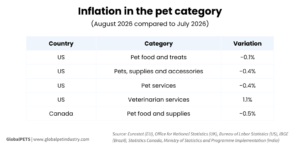
The latest data published by the US Bureau of Labor Statistics (BLS) show that CPI for pets and pet products fell 0.2% month-over-month (MoM) in August, while pet services, including veterinary, rose 0.4% MoM, accumulating a 4.8% yearly increase.
Inflation has been persistent in the American economy as a whole. Last month, it increased 0.4% on a seasonally adjusted basis after rising 0.1% in July. When compared to a year ago, the index is 3.4% higher. The BSL attributed the rise to gasoline (+3.9%), which accounted for “over one third of the monthly all items increase.”
The trajectory led the Federal Reserve to raise interest rates for the first time in three years from 3.5%-3.75% to 3.75%-4%. The Federal Open Market Committee attributed uncertainty in part to geopolitical events, stating that “domestic spending has been resilient, productivity growth is strong, and capital investment is robust.”
Canada
The clearest example of a pendulum swing in prices among the countries analyzed is Canada. After pet food and supply prices rose 0.5% MoM in July, they fell 0.5% in August. In comparison with the same month in 2025, the CPI for the category rose 0.4%.
The overall index in the country also fell, although only 0.1%, resulting in a 3% annual increase. “Year over year, prices for gasoline rose at a slower pace in August compared with July, putting downward pressure on the all-items CPI,” explained the national agency Statistics Canada.
Brazil
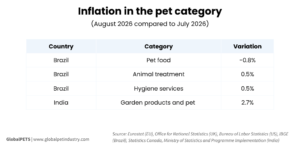
Categories continue to be volatile in Brazil. Animal treatment registered a 0.5% monthly rise in prices, animal food declined 0.8% and hygiene services grew 0.5%, according to the Brazilian Institute of Geography and Statistics.
Average inflation rate accelerated from July, with a MoM growth of 0.3%. In 12 months, the index stood at 4.2%, within the Central Bank’s target range of 1.5% to 4.5% for the second consecutive month.
The result places Brazil in the opposite direction of other economies, given that the central bank decided to further lower interest rates from 14% to 13.75% per annum after the CPI release. In a statement released after the decision, however, the Monetary Policy Committee (Copom) demonstrated that inflationary concerns are still in place.
The committee said that a set of domestic indicators point to a gradual moderation of economic activity and that “headline inflation and the average underlying inflation measures decelerated, falling below the upper limit of the tolerance interval, although still above the target.“
India
India’s combined CPI index for garden products and pets jumped 2.7% MoM after being stable in July. The uptick was driven by a 2.9% rise in urban prices compared to a 2.4% rise in rural areas.
Data from the Ministry of Statistics and Programme Implementation show inflation for all items rose 0.7% MoM and 4.82% YoY, with rural increase at 5.23% versus urban rise of 4.31%.
Other interest raises
Monetary tightening was implemented in several countries. Norway, New Zealand, South Korea and the Philippines raised their benchmark interest rates by 0.25 percentage points each between August and September.
While Korea had just implemented a second consecutive hike and the Philippines a third, Norway signaled that it may need to keep raising borrowing costs.
“It will likely be necessary to keep the policy rate elevated for a time, and the Committee is prepared to raise the policy rate further if needed to bring inflation down to the 2% target within a reasonable time horizon”, says Ida Wolden Bache, Governor of the Norwegian central bank.
Without a clear outlook for the end of the conflict in the Middle East and the normalization of energy and fuel prices, uncertainty is expected to continue putting pressure on economies around the world.
Share this story:
One click prioritizes GlobalPETS in your search results and AI answers.