Data: Pet-friendly work policies are changing career decisions in Europe

Younger workers are more likely to factor their pets into employer decisions, but older generations are also taking animal welfare into account.
According to a new survey by Mars, more than half (55%) of European employees say they would consider switching jobs if a workplace allowed pets.
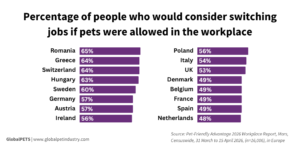
Romanians were the most open to accepting a new position in a pet-friendly workplace, with 65% of respondents saying they would. Greece and Switzerland followed at 64% each, ahead of Hungary (63%) and Sweden (60%).
At the bottom of the list are Denmark, Belgium, France, and Spain, where fewer than half of employees are willing to switch jobs for a pet-friendly workplace (49%). The Netherlands recorded the lowest share at 48%.
The Pet-Friendly Advantage (PFA) 2026 Workplace Report, commissioned by Mars and conducted by Censuswide, surveyed more than 16,000 workers across 16 European countries between 31 March and 15 April.
Nuanced preferences
According to the report, pet-friendly workplace policies were most important to employees aged 25-34, with 62% saying they would influence their choice of employer. The figure was 51% for those aged 45-54, indicating that the preference is not limited to younger workers.
Among current pet owners, 65% said such policies would influence their choice of employer. Meanwhile, 71% of non-pet owners would be more likely to get a pet if their workplace offered more supportive policies.
Europeans favored workplace changes to support pet-friendly offices, including increased access to outdoor spaces (80%) and more regular breaks (81%), which they said benefit everyone in the workplace.
Employee expectations
Mars said the rise of return-to-office mandates has increased interest in pet-friendly workplaces, with half (50%) of employees believing companies with pet-friendly policies are more supportive of the shift back to office-based work.
Policies that involve pets are more important than workplace perks such as discount schemes, cycle-to-work programs, free snacks and after-work social events for over a third (37%) of respondents. Meanwhile, 35% ranked them ahead of enhanced benefits such as parental leave and private healthcare.
The report showed that this preference is more pronounced among younger workers. More than 4 in 10 (44%) respondents aged 18-24 said these benefits matter more than “soft” perks, compared to 28% of those aged 55 and older.
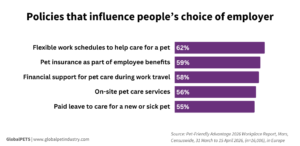
Employees also identified several pet-related benefits they would like employers to offer. Flexible work schedules to help care for a pet topped the list (62%), followed by pet insurance (59%), financial support for pet care during work travel (58%), on-site pet care services (56%) and paid leave to care for a new or sick pet (55%).
Extended perceived benefits
More than 4 in 5 (81%) surveyed employees said a pet-friendly workplace fosters a more relaxed and positive culture. For instance, a similar number (79%) believes it creates more opportunities for spontaneous social interaction among colleagues, while 74% agreed that the presence of animals helps reduce stress levels.
In addition, about a third of Europeans said a well-managed pet policy signals that a company cares about employee wellbeing (33%), makes the office a more desirable place to work (31%) and reflects a more forward-thinking workplace culture (30%).
Only 16% of respondents said a formal, well-managed pets-in-the-office policy would negatively affect the professional workplace environment.
Information gaps
Growing demand for pet-friendly workplaces is prompting companies to highlight such benefits to attract talent. Citing data from hiring platform Indeed, the report said UK job postings mentioning “dog friendly” have increased 14-fold since 2019.
However, more than half (55%) of employees said they do not know where to find information about a company’s pet-friendly policies when searching for a job. The information gap was widest in Switzerland (66%) and narrowest in the Netherlands (47%).
The report also found that one-third (33%) of workers said their employer has pet-friendly policies but does not advertise them in job postings.
Share this story:
One click prioritizes GlobalPETS in your search results and AI answers.