Musti Group increases sales in H1, but e-commerce platform change affects online business
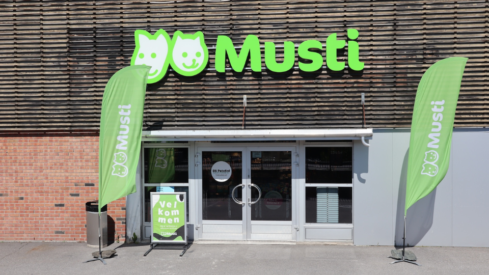
Exceptional growth in Norway helped the retailer, but investments and expansion are weighing on profitability.
Musti Group’s net sales rose 14.7% year-over-year (YoY) to €277.1 million ($315.5M) from January to June 2026. Although Norway saw the strongest increase, the retailer says the acquisition of Portuguese pet specialty retailer ZU in December 2025 contributed €17.2 million ($19.6M) to net sales.
Like-for-like store sales grew 3% in the first 6 months of the year (H1), with improved performance in all segments, the company reports. Online sales increased by 7.3%, accounting for 22.1% of total revenue.
Gross margin improved 1 percentage point (pp) to 44.2%, “mainly driven by the investments during the last year, especially the increased share of production of own brand food in the own factory,” Musti says.
However, the company recorded a net loss of €7.8 million ($8.9M), widening the loss recorded during the same period in 2025 of €4.4 million ($5M).
“Our profitability continues to be affected by strategic investments in growth and scalability. Initiatives include digital platform development, logistics improvements, ERP investments and assortment optimization,” CEO David Rönnberg says.
The retailer views these costs as temporary, expecting the investments to improve efficiency, scalability and customer experience and support long-term growth.
Q2 insights
The Nordic pet player achieved net sales of €138.5 million ($157.6M) in the second quarter of the year, a rise of 13.8% YoY. Like-for-like sales growth was 2.1%, negatively affected by the re-platforming of its e-commerce offering, Musti says.
This platform change also impacted online sales in the quarter, which expanded by only 5.1%, with like-for-like growth of 1.3%. As a result, digital channels’ share of total sales declined from 23.2% in 2025 to 21.4% this year.
The number of store locations grew to 522 in the quarter from 420 in 2025, including both stores and veterinary clinics, while the number of customers grew to 1.9 million from 1.8 million a year ago (not including the Baltics and ZU).
“Store traffic reflects resilient underlying demand across our core markets and the expansion of our customer base to 1.9 million pet parents demonstrates the ongoing appeal of our network and its offering,” Rönnberg says.
Market breakdown
Net sales in Norway grew by 24.3% in Q2 and 24.9% in H1. The first-half revenue totaled €48.5 million ($55.2M). According to the CEO, the country was also able to grow profitability in the period, with an earnings before interest, taxes, depreciation and amortization (EBITDA) margin of 25.8% – 2.5 pp above the year before.
The country saw strong like-for-like growth of 11% during H1, but results also benefited from the NOK exchange rate and the acquisition of Petco Retail in May, which operates 3 locations.
Sweden had a 6.7% rise in revenue in Q2, and 7.7% in H1, with sales for the 6 months amounting to €97.1 million ($110.6M). The growth was driven by the opening of 8 directly operated locations and 2 acquired units in H1 as well as a stronger SEK exchange rate against the euro.
“Sweden maintained positive momentum in customer acquisition and network expansion, which will be further enhanced by our acquisition of ICA’s Gaston stores and developing long-term partnerships,” the CEO says. The company just announced the acquisition of 3 pet stores from ICA, one of the country’s largest grocery retailers.
Finland saw a small decline of 0.1% in revenue in Q2, while growth during the period was 1.4%. H1 sales totaled €96.5 million ($109.9M). Musti attributed the result to a 0.4% drop in like-for-like sales, with online performance also negatively impacted. Two directly operated locations were opened during this time.
New markets
The segment that includes the Baltic and Portuguese operations reported a 101.6% jump in revenue in H1 to €34.9 million ($39.7M).
According to the retailer, “The financial performance in Baltics improved as the integration process reached its final phase but was negatively affected by the weak consumer climate in the Baltic markets.”
Outlook
For the full financial year, the company expects a gradual return to its long-term growth rate of 4%.
It expects this recovery to be supported by a forecast increase in the number of puppies and kittens, alongside improving consumer spending power across European markets toward 2027. The company cites an improving GDP outlook, wage increases and stable interest rates.
Share this story:
One click prioritizes GlobalPETS in your search results and AI answers.