Inflation snapshot: Energy prices fuel uneven pet product trends in April

Europe recorded faster inflation in pet products in April, while the US and Canada showed signs of stabilization. Meanwhile, EU inflation is forecast to rise to 3.1% in 2026.
Prices for pet food and supplies showed mixed movements across markets in April, with no clear regional alignment.
The US saw a sharp increase in March’s consumer price index (CPI), followed by a decline in April, pointing to a normalization. Canada remained broadly unchanged, while Europe, which recorded moderate growth in March, saw average pet product prices rise 3 times that pace.
However, the countries share a similarity: higher energy and fuel prices have put pressure on official inflation and spilled over into other sectors, a scenario that has persisted since March, when the crisis in the Middle East began.
Europe
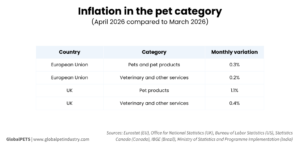
In the European Union, prices of pets and pet products rose 0.3% month-over-month (MoM) in April, up from a modest 0.1% rise in March, according to data from the European statistical office, Eurostat.
Estonia registered the highest increase (9.2%), followed by the Czech Republic (2.7%). Belgium, Bulgaria, France, Ireland, Italy, Austria, Lithuania and Latvia, on the other hand, saw falling prices.
Veterinary and other pet services reported a monthly inflation rate of 0.2%, down from 0.3% the previous month. The Netherlands saw the largest price increase in the bloc (2.7%), followed by Denmark (1.5%).
Although the price of goods is increasing sharply this month, it has grown by only 0.4% over the year. Services, on the other hand, have accumulated inflation of 3.6% over 12 months.
In the whole economy, the average CPI in the EU rose 1% MoM. On an annual basis, inflation in the bloc reached 3.2% in April, up from 2.8% in March.
In the Euro Area, energy prices rose 3% monthly and 10.8% YoY, more than double the 5.1% annual rate recorded in March. However, the category contributed 0.99 percentage points (p.p.) to overall inflation in the area.
The services sector recorded more moderate inflation, with CPI rising 1.1% monthly and 3% annually. However, it remained the largest contributor to the Euro Area inflation, accounting for 1.38 p.p. of the annual rate.
UK
In the UK, monthly inflation for pet products remained high, rising from 1% in March to 1.1% in April, following a sharp acceleration the previous month.
Vet services prices increased by 0.4% in April, a slowdown from the 0.7% recorded a month earlier.
Prices in the whole economy grew 0.8% MoM, up from 0.6% in March. In the 12 months to April, the rate rose by 3%.
Housing and household services made the largest downward contribution to the annual rate. Lower prices followed the UK government’s energy bill measures, which aim to reduce household energy costs by an average of £150 ($200/€173) from April through policy changes lowering per-unit prices, according to the Office for National Statistics (ONS).
On the other hand, the largest upward contribution came from a large increase in motor fuel prices. Rising by 16.6 pence ($0.22/€0.19) per liter between March and April 2026, it hit the highest price in 4 years.
“The average price of petrol stood at 156.8 pence ($2.1/€1.8) per litre in April 2026, the highest price since November 2022, when it was 163.6 pence ($2.2/€1.9) per litre because of the war in Ukraine,” the ONS says.
US
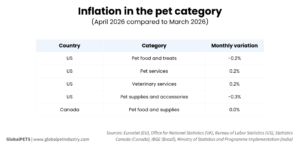
If US pet owners faced the strongest cost pressure in March, prices began to stabilize in April. CPI for pet food and treats fell 0.2%, while prices for pets, pet supplies and accessories declined 0.3%. Over the past 12 months, however, the categories still recorded increases of 2.2% and 1.9%, respectively.
Prices for pet and veterinary services rose more moderately in April, by 0.2% MoM each. On an annual basis, the categories were up 6.6% and 5.5%, respectively.
The overall CPI rate grew by 0.6% in the country, slowing from 0.9% the month before.
Once again, the US Bureau of Labor Statistics highlighted pressure from the energy index, which rose 3.8% in April and “accounted for over 40% of the monthly all items increase,” according to the agency.
The federal agency also noted monthly increases in categories including shelter, food, household furnishings and operations, airline fares, personal care, apparel and education.
Canada
In Canada, prices for pet food and supplies remained unchanged between March and April. Over the past 12 months, prices have been down by 2.2%.
The average CPI rate in the country rose 0.4% MoM and 2.8% YoY, up from 2.4% in March.
Statistics Canada again pointed to higher energy prices as a key driver of the acceleration in headline CPI, with energy up 19.2%, gasoline rising 28.6%, and fuel oil and other fuels increasing 41.3% in 12 months. “Excluding gasoline, the CPI rose at a slower pace YoY in April (+2%) compared with March (+2.2%),” it explains.
Additionally, the government agency says the removal of the consumer carbon levy in April 2025, which had previously reduced fuel prices, “has now fallen out of the 12-month movement, putting upward pressure on the all-items CPI.”
Brazil
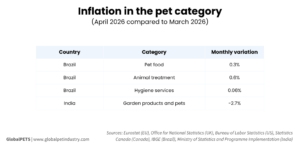
After strong price growth in March (2.3%), hygiene services saw a moderate increase in April in Brazil, at only 0.06%. Animal treatment prices increased by 0.6%, while pet food rose by 0.3%.
The average inflation rate in the country totaled 0.7%, after accelerating 0.9% in March. However, over the last 12 months, the index stood at 4.39%, above the 4.14% of the year before, according to the Brazilian Institute of Geography and Statistics (IBGE).
The greatest impact was observed in the food and beverages group, followed by the health and personal care group. Although several food items dominate the month’s biggest price increases, fuels such as diesel and gasoline have also risen, as have postal services.
Following the announcement, financial market expectations for inflation rose, and forecasts indicate that the CPI will end 2026 with a 4.92% increase. A month before, the forecast was 4.8%.
India
India’s combined index for garden products and pets fell 2.7% MoM. On an annual basis, it rose 5.9%, according to the Ministry of Statistics and Programme Implementation, after increasing 8.5% in March.
In April, garden and pet inflation was higher in rural areas at 6.5% than in urban areas at 5.4%.
Overall inflation increased at a more moderate pace, with the general CPI rising 3.5% year over year, driven by stronger price growth in rural areas than in urban areas. Among macro segments, personal care, social protection and miscellaneous goods and services registered the highest increase, at 17.7% YoY.
General outlook
The Organisation for Economic Co-operation and Development (OECD) noted in a recent report that inflationary pressures are coming not only from energy but also from key commodities.
At the end of April, the World Bank forecasted that energy prices are projected to surge by 24% this year to their highest level since Russia’s invasion of Ukraine in 2022. It also predicted that commodity prices would rise 16% in 2026, driven by higher fertilizer costs and record prices for several key metals.
In developing economies, inflation is now projected to average 5.1% in 2026, the World Bank says. In 2025, this figure was 4.7%.
According to the Organisation for Economic Co-operation and Development (OECD), inflation across the G20 – the group of major economies representing around 80% of global GDP – is projected to rise by 4% in 2026. This is 1.2 percentage points higher than previously expected.
Argentina (31.3%) and Turkey (26.7%) lead the inflation projections in the group, followed by Russia (6.4%), Brazil (4.1%) and Mexico (3.8%). China, on the other hand, is at the bottom of the G20 list, with a 1.3% inflation rate forecast for 2026.
The OECD expects price pressures to ease again in 2027, to a 2.7% increase if “assumed fading of energy price pressures” continue.
Spreading shock in Europe
The European Commission released its Spring Economic Forecast on 21 May, projecting EU inflation to rise to 3.1% in 2026. This is an upward revision of a full percentage point compared to the Autumn 2025 Forecast.
The rate is expected to ease to 2.4% in 2027, slightly below the 2.5% recorded last year. “Moreover, the inflation forecast for 2027 is influenced by the postponement of the roll-out of the new EU Emissions Trading System (ETS2),” the Commission notes.
The institution also says that although the current price shock differs from the 2022 energy crisis triggered by Russia’s war in Ukraine, it is still expected to spread throughout the economy, affecting production chains, agriculture, distribution and transport services, with unprocessed food expected to be impacted more quickly.
The Commission says upward pressure would be reinforced by stronger-than-previously-expected wage growth, as workers seek to preserve purchasing power. “Inflation in Central and Eastern Europe is expected to remain higher, reflecting both the region’s greater share of energy in consumption baskets and more dynamic nominal wage growth.”
Share this story:
One click prioritizes GlobalPETS in your search results and AI answers.