Inflation snapshot: Pet product inflation cools in most major economies

Pet food and supplies prices stabilized or declined in most European and American markets, while veterinary services registered slight increases.
Pet product and service prices began to follow more consistent patterns across the markets tracked by GlobalPETS.
In contrast to the varying trends observed in recent months, the Consumer Price Index (CPI) for pets, food and supplies remained stable in the European Union, the UK and the US, and even declined in Brazil in September. Canada was the exception, registering a sharp increase over the month.
Economies continue to face pressure from rising energy and fuel prices, with knock-on effects on the cost of manufactured goods. However, while inflationary pressures on food prices have varied across regions, organizations are concerned about their potential impact on the category. This suggests that categories previously shielded from inflationary pressures may experience delayed increases in consumer prices.
Europe
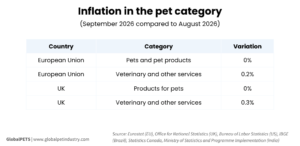
In the European Union, prices for pets and pet products remained unchanged month over month (MoM) in September (0%), while veterinary and other pet-related services rose slightly, by 0.2%.
The bloc experienced broader inflationary pressure, with annual inflation across all items rising from 3.2% in August to 3.8% in September, according to Eurostat, the EU’s statistical office.
Energy prices recorded the highest monthly increase (4%), while unprocessed food prices also rose, by 1.2% MoM. This offset the 0.3% decline in prices for processed food, alcohol and tobacco.
UK
The UK also recorded unchanged prices for pet products in September (0%), following a 1% increase in August. Veterinary and other pet services rose by 0.3%, slowing from the previous month’s 0.4% increase.
As in the EU, the UK’s overall CPI increased by 0.4% MoM, while annual inflation rose from 3.1% in August to 3.5% in September, according to the Office for National Statistics (ONS).
Transport, particularly motor fuels, continued to drive inflation. Food and non-alcoholic beverage prices, meanwhile, fell by 0.2% over the same period, suggesting that retailers have so far absorbed some of the pressure from rising costs.
Organizations in the country are concerned, however, that food prices may not remain stable for long. “Although the annual rate of inflation for food and non-alcoholic beverage prices has remained the same for the last three months, organisations like the Food and Drink Federation expect food inflation to arrive later and persist for longer,” the ONS says.
“This is partly because pressure on household budgets, competition and retailer resistance to price increases have limited manufacturers’ ability to pass on higher costs,” the agency adds.
At the end of October, UK retail trade body the British Retail Consortium said “the dam is starting to break on the huge wave of costs retailers have absorbed over the last two years.”
US
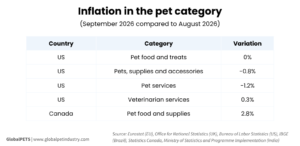
Prices for pet food and treats also remained unchanged in the US, while those for pets, supplies and accessories fell by 0.8%. Pet services registered a sharper decline of 1.2%, while veterinary services rose by 0.3% MoM.
Overall, US inflation accelerated to 0.6% MoM in September, compared with 0.4% in August. The annual CPI rate reached 3.7%, with higher energy prices, particularly fuel and services, contributing significantly to the increase, according to the US Bureau of Labor Statistics (BLS). Fuel oil, for example, recorded a 74.2% year-over-year increase.
Food prices, meanwhile, eased after five consecutive months of increases. The index for food consumed at home fell by 0.1% MoM, offsetting the 0.2% increase in prices for meals consumed away from home. Year over year, food prices were 2.5% higher than in September 2025.
According to Reuters, some of the largest consumer goods and food companies, including Coca-Cola and Nestlé, “have warned of further price hikes next year to cover rising costs even as shoppers remain reluctant to splurge on groceries.”
Canada
Canada recorded the strongest monthly increase in pet-related product prices among the markets covered, with pet food and supplies rising by 2.8%. This followed a 0.5% decline in August.
In the wider economy, the CPI rose by 0.1% MoM and 3.1% year over year, with the country’s official statistical agency, Statistics Canada, reporting that energy prices increased at a faster pace than in previous months.
In contrast to expectations in the UK, Canada showed signs of easing food inflation, which slowed from a 2.8% year-over-year increase in August to 1.7% in September.
“Although price levels remain high, this was the smallest yearly increase since May 2024 (+1.5%), and the second consecutive month where grocery price growth increased at a slower pace than the all-items CPI,” Statistics Canada reported. The agency highlighted that food prices had risen by a cumulative 33% since September 2020.
This slowdown may reflect retailers’ efforts to contain further price increases. For instance, in April, Canadian grocery retailer Metro said it was negotiating with suppliers to delay passing cost increases and fuel surcharges on to consumers. It also said customers were increasingly turning to discount stores.
Earlier this year, pet specialty retailers in other countries also adopted discount strategies to attract customers following price increases linked to the conflict in the Middle East.
Brazil
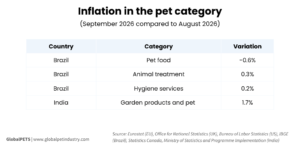
Pet food prices fell by 0.6% MoM in Brazil. Animal treatment costs rose by 0.3%, while hygiene services increased by 0.2%, according to the Brazilian Institute of Geography and Statistics (IBGE).
Weather-related issues reduced food supply, driving prices up by 0.8% in September and ending three consecutive months of declines.
Overall, the country’s CPI increased by 0.82% MoM in September, marking the highest monthly increase since March (0.9%), according to the institute. The rise was primarily driven by the end of a tax benefit on electricity bills, which pushed up housing costs.
India
India’s combined CPI index for garden products and pets rose by 1.7% in September compared with August. Rural prices drove the increase, rising by 2.2% MoM, while urban prices increased by 1.3%.
Across the economy, the general CPI rose by 0.7%, again driven by rural prices, which increased by 0.75%. The Consumer Food Price Index rose by approximately 1.3% MoM, while annual food inflation jumped to 7.7%.
Share this story:
One click prioritizes GlobalPETS in your search results and AI answers.