Analysis: Pet retailers grow revenue, but profitability concerns weigh on investor confidence

GlobalPETS examines how specialty stores are adapting to margin pressure, shifting channels and changing consumer expectations.
In June, the financial intelligence and research company S&P removed Pet Valu, Canada’s largest retailer of pet food and supplies, from the S&P/TSX Composite Index, the headline index for the Canadian equity market.
Since March, the company’s shares have been on a downward trajectory, reaching an all-time low in May, 60% below the all-time high recorded in February 2023.
British retailer Pets at Home and Finland-based Musti Group are also trading down around 60% from their peaks, although, unlike their Canadian counterpart, they are not at their lowest price point.
For US-based Petco, the difference is even more extreme: 90% below the highest share price recorded by the company at its Nasdaq debut in January 2021.
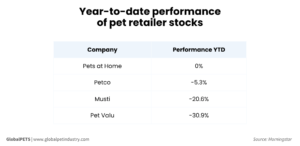
Beyond the comparison with their peaks, 3 out of the 4 publicly traded specialty retailers analyzed have declined in value so far this year – between 5.3% and 31% – pointing to investor distrust.
Financial results
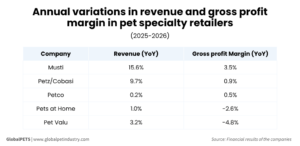
An analysis of the 2025 and 2026 results of 5 specialty retailers in different regions shows that, even with increased revenue, some companies are unable to expand their gross profit margins. And when they do manage to raise them, the increases tend to be smaller.
In specific cases, such as Musti Group, growth was strongly linked to acquisitions, as the 3.9% increase in comparable sales was less than the overall growth of 15.6%. The Finnish company acquired the Portuguese player ZU during the fiscal year (FY) 2026.
Other results show contrasting trends. Pet Valu reported flat same-store sales in the first quarter of FY2026, while Brazil’s Petz and Cobasi posted comparable sales growth more in line with the increase in total revenue.
Profitability also diverged: Petco improved its operating margin from 1.05% to 1.6%, whereas Musti’s slipped from 0.1% to -1.0%.
“Inflation makes this situation more challenging because it compresses profitability from both sides. Consumers are resisting price increases, while retailers are still dealing with higher costs across logistics, rent, labor, utilities, and inventory,” Rahul de Singh, Digital Market Expert at global market research Future Market Insights, tells GlobalPETS.
This means that even if top-line sales remain stable, he says, profitability can weaken meaningfully. “Retailers with high fixed costs, weak supplier terms, poor inventory control or limited online capability are likely to feel the pressure much more sharply,” de Singh adds.
The double battle of pet specialty retailers
According to Lauren DeVestern, Partner and Managing Director of Consumer Practice at L.E.K. Consulting, there is a distinction between the weaker demand in the pet market in general, due to normalization after the peak of Covid, and the more specific pressures faced by pet retailers, also affected by online competition.
“In response, retailers are investing in value-added services, such as grooming or veterinary care, which are difficult to replicate online and can help support store traffic and customer loyalty,” DeVestern tells PETS International.
Over the past 2 months, GlobalPETS has covered several initiatives in the sector, including investments by Italian retailer Arcaplanet and US-based Pet Supplies Plus investing in customer service to improve satisfaction, and Pets at Home, Fressnapf, Arcaplanet and Zooplus bringing in leadership from fast-moving consumer goods (FMCG) segments.
“Larger chains are additionally strengthening omnichannel capabilities, including online assortment visibility, convenient pickup and same-day delivery, while using their store networks as a competitive advantage rather than attempting to compete directly with online-only retailers,” she adds.
Among the retailers analyzed, while Musti’s online share of sales declined from 24% in Q1 2025 to 22.7% in Q1 2026, Petz-Cobasi lifted e-commerce’s share of revenue from 40.3% to 41.4% in the same period.
Other tactical tools
Price adjustments also enter the fray, with players engaging in different strategies. “Retailers are adapting their commercial playbook by sharpening entry-price-point offers and expanding private-label ranges,” says Gilles Vanhouwe, Director at investment company Verlinvest. In May, European pet retailers announced discounts to retain cautious consumers.
But improving profitability also involves the funds themselves, through improved operational efficiency. “These improvements can come from productivity gains through the adoption of new technology, including increasingly AI-enabled software, from scale benefits such as density in store network operations, or from switching suppliers and partners,” Vanhouwe adds.
Offering smaller pack sizes, using loyalty-based promotions and improving subscription or autoship models complete the list of actions retailers are taking to attract customers, de Singh states. From the market, we have seen Raiffeisen Markt, Kölle Zoo and Pet Supplies Plus investing in loyalty programs and relaunching apps.
Forecast
The pressure on consumer spending has been around for several quarters, says Vanhouwe, mainly driven by a volatile macroeconomic environment.
But the overall pet demand outlook is likely to improve, Vanhouwe and DeVestern agree, especially because pet acquisition is stabilizing, volumes are picking up and inflation is easing on the products side – prices have fallen or remained unchanged in May in the EU, US, and UK.
For de Singh, however, the pressure on pet retail could last longer than many companies expect because “consumers have become more value-conscious, and some of that behavior may remain.”
If general consumer caution is external to the pet market, temporary and about to change, the loss of market share to other channels is a more structural issue for specialty retailers and less likely to reverse easily, according to the L.E.K. analyst.
Therefore, all these investments in differentiation to defend traffic and increase consistency we have been seeing in the past quarters (from apps to loyalty incentives to vet services and rearranged assortments) are likely to gain further adoption and evolve in offering, technology, and range in the quarters to come.
Share this story:
One click prioritizes GlobalPETS in your search results and AI answers.