Inflation snapshot: Pet product prices cool in May while services remain under pressure

Pet inflation sent mixed signals across the EU, UK, US, Brazil and India in May. GlobalPETS dives into the latest CPI data.
After rising significantly for 2 consecutive months, pet inflation started to ease in key markets in May for both supplies and food, as measured by the Consumer Price Index (CPI) and Harmonised Indices of Consumer Prices (HICP).
However, prices for veterinary and general pet services continued to rise across all countries analyzed, indicating a persistent upward trajectory.
Additionally, monetary policy in some of the countries analyzed also followed opposing paths, from expansionary to contractionary.
Europe
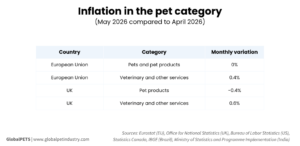
In the European Union, prices for pets and pet products remained stable in May compared to the previous month, according to data from the Eurostat statistical office. Year-to-date, the category registered a 0.7% increase, with a price increase recorded in April largely maintained in May.
The Baltic countries led the monthly increases: in Latvia, prices rose 6.6% month-on-month (MoM), while in Lithuania, they rose 3.6% MoM. Among the Nordic countries, Finland had the highest inflation (1.3%), while in Central Europe, Belgium (0.5%), Austria (0.4%), France and Italy (3% each) registered the highest rates.
Veterinary and other pet services reported a monthly inflation rate of 0.4% in both the EU and the Euro Zone, indicating that after the initial shock of rising product prices last month, service inflation has once again become prominent in the bloc.
At a country level, the most pressured markets were Belgium (6%), Bulgaria (2.2%), Hungary (1.3%), Romania (1.1%) and Finland (0.9%).
EU economy
Across the whole economy, the average CPI in the Euro Area and in the EU rose 0.1% MoM, a deceleration from the month before, when prices rose 1%. On an annual basis, inflation in the area reached 3.2% in May, from 3% in April.
Services led price increases (1.61 percentage points, p.p.), followed by energy (0.98 p.p.), food, alcohol and tobacco (0.36 p.p.), and non-energy industrial goods (0.23 p.p.).
In response, the Governing Council of the European Central Bank (ECB) decided to raise interest rates by 25 basis points on 11 June. “The war in the Middle East is generating inflation pressures, and the decision is robust across a range of scenarios mapping out how the shock might evolve and affect the medium-term outlook for the Euro area,” the organization said.
The ECB expects headline inflation to average 3% in 2026, 2.3% in 2027 and 2% in 2028, an estimate that was updated from March based on higher energy prices and their impact on food, goods and services.
UK prices
In the UK, monthly inflation for pet products began to normalize after 2 months of sharp increases. Data from the Office for National Statistics (ONS) show a 0.4% decline in the CPI for the category in May.
Prices of veterinary and other pet services, on the other hand, continued to rise at a monthly rate of 0.6%.
Across the UK economy, prices grew 0.2% MoM, down from 0.8% in April and back to the same growth rate as in May 2025. In 12 months, the CPI rose by 2.8%.
“Transport made the largest upward contribution to the monthly change, while food and non-alcoholic beverages made the largest, partially offsetting, downward contribution,” the ONS analyzed.
Having risen by 6.8% in the 12 months to May 2026, the transport division’s annual rate was the highest recorded since December 2022, the governmental agency adds.
Retail pressure
For the British Retail Consortium, the trade association for UK retailers, the smaller rate registered in the month was helped by supermarkets cutting prices of food and beverages, as well as fierce competition between sellers.
“Retailers are already shouldering a heavy burden of costs, from higher National Insurance contributions and the triple packaging tax to supply chain disruption triggered by the Iran conflict,” it says.
Negative pet rates in the US…
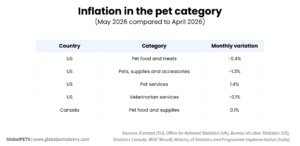
US pet owners continue to see relief in the cost of supplies. CPI for pet food and treats fell by 0.4%, while prices for pets, pet supplies and accessories declined even further, by 1.3%. The latter is at nearly the same price level as a year ago, with year-over-year (YoY) inflation at 0.1%.
Veterinary services also became slightly cheaper (-0.1%), while prices for other pet services jumped 1.4% in May compared to April. On an annual basis, prices for both categories combined are growing by 5.1%.
…And a concerning overall inflation
The general CPI rate rose by 0.5% in the US, slowing from 0.6% the month before. However, the all-items index rose 4.2% for the 12 months ending May, reaching its highest level in 3 years.
Energy accounted for an even greater share of the monthly increase, up from 40% in April to 60% of the monthly all-items increase, according to the US Bureau of Labor Statistics. “Indexes that increased over the month include food, communication, airline fares, medical care, personal care and recreation,” the agency adds.
At the first meeting of Kevin Warsh as Chair of the Federal Reserve, the Federal Open Market Committee (FOMC) held US interest rates at the same level, between 3.5% and 3.75%, on 17 June.
The FOMC recognizes that “inflation remains elevated relative to the Committee’s 2 percent goal, in part reflecting supply shocks that have driven price increases in certain sectors, including energy.” However, the decision also took into account the expansion of economic activity, productivity and capital investment, it said in a statement.
Prices in Canada resume rising
After months of declining prices or stagnation, the monthly inflation index for pet food and supplies in Canada increased slightly, rising 0.1% in May. On a year-over-year basis, however, the index remained 0.6% lower than in May 2025.
The Canadian economy as a whole experienced stronger inflationary pressure, with prices increasing 1.0% month over month and 3.2% year over year.
While higher gasoline prices continued to drive the acceleration in the headline CPI, the national statistics agency noted that even excluding gasoline, CPI rose at a faster annual pace in May (+2.2%) than in April (+2.0%).
Increasing prices in Brazil
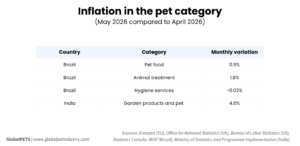
Animal treatment and pet food prices grew faster in May than in April, by 1.8% and 0.9%, respectively. On the other hand, hygiene service prices continue to normalize following a March hike. Last month, they fell slightly by 0.03%.
The average inflation rate in the country continues to decelerate. It rose by 0.6% in May, down from 0.7% in April and 0.9% in March. “Food prices weighed heavily on Brazilians’ budgets in May, accounting for half of the inflation rate,” the Brazilian government agency says.
Over the last 12 months, the index stood at 4.7%, according to the Brazilian Institute of Geography and Statistics (IBGE), which is above the Central Bank’s target ceiling of 4.5%. According to the agency, the last time the 12-month accumulated figure fell outside the ceiling was in October 2025.
Even with inflation outside the target range, the country’s Central Bank decided to reduce the economy’s basic interest rate by 0.25 p.p., to 14.25% per year. According to the government, the measure aims for a “gradual reduction in the cost of credit in the coming months, influencing financing, loans and household consumption.”
Rural areas drive price upticks in India
India’s combined index for garden products and pets grew 4.6%, according to the Ministry of Statistics and Programme Implementation.
In May, garden and pet inflation was higher in rural areas (5.2%) than in urban regions (4.2%).
Overall inflation increased at a more moderate pace, with the general CPI rising 3.9% YoY. Food inflation was higher, at 4.8%, but personal care, social protection and miscellaneous goods and services led the rise with 18.5%.
Share this story:
One click prioritizes GlobalPETS in your search results and AI answers.