Data: US consumers report the least difficulty purchasing pet products

Although consumer confidence remains historically weak, the category continues to be resilient compared to other everyday expenses.
According to a new survey by research and data analytics firm PYMNTS Intelligence, 3 out of 10 US consumers reported difficulty purchasing pet supplies as of January 2026.
This was the lowest share among the everyday expense categories tracked, compared with groceries and household essentials (89%), clothing and personal care items (47%), dining out and food delivery (47%), and entertainment and social activities (33%).
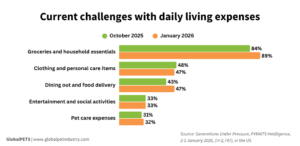
The findings come from the report Generations Under Pressure: How Younger Consumers Are Coping With Higher Living Costs, published in February 2026. The survey polled 2,747 US consumers between 2 and 5 January.
Generational divide
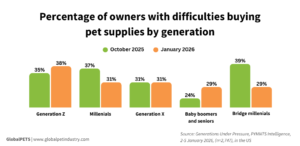
Gen Z recorded the highest share of respondents reporting difficulty purchasing pet supplies, at 38%, followed by Gen X and millennials at 31% each. Baby boomers and seniors, as well as bridge millennials, were the least likely to report difficulties, at 29% each.
Compared with October 2025, the share of consumers reporting difficulty purchasing pet supplies increased by 1 percentage point (p.p.) overall, suggesting rising affordability pressures.
The increase was most pronounced among baby boomers and seniors, whose share rose by 5 p.p., followed by Gen Z (3 p.p.). By contrast, the figure declined among bridge millennials (-10 p.p.) and millennials (-6 p.p.), while remaining unchanged among Gen X.
Pet care remains a priority
In a separate survey conducted between 30 March and 9 April, PYMNTS Intelligence found that 71% of reactive consumers (an individual who buys a product or contacts a brand only in direct response to an external trigger, such as a promotional sale) did not identify pet care as a challenge when it came to non-essential spending. Instead, they reduced spending in other categories.
The report, The Cutback Economy: How Age, Behavior and Financial Pressure Shape Consumer Spending, which surveyed 2,283 US adults, is the latest installment in the Generational Pulse series. It identified pet care as a “protected” spending category, noting that brands in this segment continue to show strong resilience among reactive consumers.
How consumers manage expenses
Most respondents managed rising living costs by adjusting their spending and income. Cutting back on everyday spending was the most common strategy, cited by 69% of respondents overall. The share was highest among baby boomers and seniors (75%), followed by Gen X (74%).
More than half (52%) also avoided making large purchases or investments. This was most common among baby boomers and seniors (60%) and bridge millennials (52%).
Other respondents took steps to boost their finances. Over a quarter (27%) increased the amount they saved, led by Gen Z (40%) and millennials (31%).
Meanwhile, 26% took on additional work or income sources, with bridge millennials (37%) and millennials (34%) reporting the highest shares. Another 18% negotiated bills or payment plans.
Consumers also turned to credit and other forms of financial support. Overall, 22% borrowed money from family or friends, 18% used buy now, pay later (BNPL) or installment plans, while 12% sought financial assistance.
Consumer sentiment
The latest data from the University of Michigan Consumer Sentiment Index showed that US consumer sentiment stood at 49.5 in June 2026.
According to the index, the reading is 40.9% below its long-term mean of 83.8 based on data dating back to 1978.
The June reading also marked a 3.8-point decline from 53.3 in both January 2026 and October 2025, indicating that consumer confidence continued to weaken during the first half of the year.
Share this story:
One click prioritizes GlobalPETS in your search results and AI answers.