Pet industry pulse (I): Retailers post growth as expansion and loyalty drive sales

Store expansion, acquisitions and incentives supported faster growth, while loyalty and recurring revenue drove more modest gains.
All pet retailers analyzed by GlobalPETS registered a net revenue increase in the second quarter of 2026, though with wide variation in size and drivers.
Overall, the rise was driven by actions to boost volume, such as store expansion, acquisitions and discounts, alongside investment to strengthen services, loyalty and subscription programs.
A closer look shows that faster-growing retailers generally benefited from a mix of volume and expansion, while slower increases were more tied to recurring revenue.
Net sales outlier
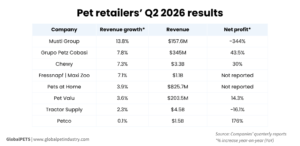
Finnish chain Musti Group led in percentage growth and was the only company to post a double-digit increase: 13.8% year-over-year (YOY), to $157.6 million (€138.4M). The company expanded its store footprint significantly, from 420 to 522 in one year, and acquired the Portuguese chain ZU in December.
Comparable net sales growth, excluding the ZU acquisition, was 6.6% during the period. The retailer also had help from currency exchange rate changes in the Swedish and Norwegian kroner, an uptick in in-store sales and expansion of veterinary clinics (the latter saw a 17% yearly jump).
The 7% rise group
Three major retailers posted similar results. In Brazil, Petz-Cobasi posted a 7.8% sales jump, while Chewy increased its revenue by 7.3% in the US, and the European retailer Fressnapf | Maxi Zoo recorded a 7.1% increase.
Despite leading their respective regions, the retailers differ significantly in size. Chewy’s net revenue for the quarter was $3.3 billion (€2.9B), whereas Fressnapf recorded $1.1 billion (€930M) and Petz-Cobasi sold $411.8 million (€302M).
Chewy and Fressnapf grew from different directions. The American company attributed its growth to new active customers, veterinary care services, and its fresh and frozen portfolio. The European counterpart cited price investments made this year to drive store volumes. In Germany, the retailer announced a permanent price reduction on over 500 high-demand items in May.
The Brazilian chain said its growth was volume-driven, supported by service offerings (vet and grooming), a recovery in customer traffic and “improvements in product assortment, pricing and commercial execution,” sales competitions and incentive campaigns.
More modest increases
Trailing with roughly half that growth rate are the British retailer Pets at Home and the Canadian chain Pet Valu, with yearly rates of 3.9% and 3.6%, respectively.
Both retailers saw similar drivers of performance: loyalty and services. At Pets at Home, growth came especially from recurring-revenue offerings, including Flea & Worm (a preventative parasite treatment subscription), Easy Repeat (its auto-replenishment service for pet essentials), Complete Care (a preventative veterinary wellness plan), and Vac4Life (a lifetime vaccination program).
At Pet Valu, CEO Greg Ramier noted that its loyalty program captured 90% of sales during the quarter, with the AutoShip subscription service expanding “both in absolute dollars and as a proportion of digital.”
US-based retailer Tractor Supply, whose pet business accounts for almost one-fourth of its revenue, posted slower growth of 2.3% and total revenue of $4.5 billion (€4B). This was driven entirely by new store openings, as comparable store sales declined during the period.
And finally, US-based Petco posted a very slight increase of 0.05%, with sales of $1.5 billion (€1.3B). The company attributed these flat results to “a sales disruption from the initial stronger-than-expected points redemption from our membership program relaunch.”
The profitability story
The profitability picture tells another story. Petco, with the smallest relative growth, had the biggest jump in profitability, up 176%.
This 3-digit increase includes external help: of the $38.7 million (€34M) net profit reported by the retailer, $6.8 million (€6M), or 17.5%, came from tariff refunds. Still, the company increased profits by 127% without that benefit.
Some data help to explain this. According to CEO Joel Anderson, Petco rolled out a significant number of new SKUs from well-known brands, particularly in cat treats, which have higher margins than dry kibble, and invested in its private-label offering, which can offer retailers higher margins than some branded products.
Petz-Cobasi reported the second-largest increase in net profit, at 43.5%. The companies, which merged in December, achieved these results by realizing merger synergies, consequently reducing costs, and increasing private-label penetration in sales, which reached 12.1% during the quarter, up 2.2 percentage points from the year before. Investment in services also contributed to the result.
Chewy’s net profit rose 30% in the previous quarter. CEO Sumit Singh attributed the positive results to a combination of factors, including the expansion of its Sponsored Ads portfolio, a product mix shift toward high-margin categories such as health, lower operational costs from automation and operating discipline, and vet services.
Canadian retailer Pet Valu rounds out the list of companies that posted profit growth for the quarter. Net income rose 14.3% YoY, driven primarily by higher operating results.
An analysis from the financial data platform Investing.com says that while same-store sales were flat, the company expanded gross margin and lifted adjusted earnings before interest, taxes, depreciation and amortization (EBITDA). “That points to a stronger operating mix and better leverage across the business,” the analysis says.
What is behind quarterly setbacks?
The retailers reporting profitability setbacks faced substantially different circumstances. Tractor Supply reported a profit, but it was 16.1% lower than the previous year. CEO Hal Lawton attributed it to “sales pressure.”
Musti Group, on the other hand, saw a massive setback, with its net loss nearly quadrupling due to acquisitions, digital platform development and logistics investments, which the company expects will translate into operational efficiency gains over the medium to long term.
Fressnapf and Pets at Home did not publish net profit figures and were therefore not included in the profitability analysis.
Mostly stable forecasts
After publishing their Q2 results, four retailers maintained their previous forecasts.
Reporting fiscal year 2027 (whose first quarter ended on 16 July), British company Pets at Home maintained its previous guidance of low-single-digit sales growth for its vet segment and “an underlying market growth of 1-2%, against which we expect to outperform as we roll out more initiatives through FY27” for its retail business.
Pet Valu maintained its revenue uptick range of 2% to 4% for FY2026, even as sales growth rose from 3.2% in Q1 to 3.6% in Q2. Lastly, Petco reaffirmed its full-year guidance, expecting net sales to range from flat to a 1.5% increase.
After lowering its guidance in Q1 to between $13.4 billion (€11.7B) and $13.6 billion (€11.8B), from a previous range of $13.6 billion (€11.8B) to $13.8 billion (€11.96B), Chewy maintained its outlook following its Q2 results.
Tractor Supply, meanwhile, lowered its full-year outlook to reflect its year-to-date performance. The retailer now expects net sales growth of 2.5% to 3.5%, down from its previous forecast of 4% to 6%.
Three companies didn’t offer a clear view of how they expect the fiscal year to end in terms of sales. Petz-Cobasi and Fressnapf did not include guidance in their releases, while Musti Group only said its “expectation is a gradual return to long-term market growth levels of approximately 4%.”
What these results say
Overall, the quarterly results show that revenue growth can stem from various drivers, but increased sales do not always translate into higher profitability.
Consequently, most retailers have remained cautious in their full-year projections, both because of internal business matters and ongoing uncertainty in the economic and geopolitical landscape.
For more insights:
Pet industry pulse (II): Manufacturers deliver growth despite uneven market conditions
Share this story:
One click prioritizes GlobalPETS in your search results and AI answers.