Inflation snapshot: Pet product price trends vary across major economies in July

Price trends varied by market, influencing consumer responses to promotions, brands and purchase volumes.
Almost all countries tracked by GlobalPETS reported an increase in consumer price index (CPI) rates for pet products in July compared to June, reflecting widespread price pressure on consumers.
The US was the only economy to report price declines for pet services, a move that brings relief after repeated price increases for the category in 2026.
Europe
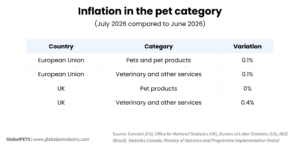
In the European Union, prices for pets and pet products, as well as veterinary and other services, grew 0.1% month-over-month (MoM) in July, according to the latest release from Eurostat, the EU’s statistical office.
Year-over-year (YoY), however, the rates differed significantly. While the CPI rate for pets and pet products was 0.3%, veterinary and other services jumped 3.5% in the period.
Monthly CPI increases for products were led by Nordic and Western countries, with Belgium (2.8%), Denmark (1.1%) and Norway (1%) reporting the greatest changes.
Meanwhile, the East reported the steepest monthly rises in service prices, especially Türkiye (5.8%), Bulgaria (4.1%) and Latvia (1.6%).
Across all items, European Union annual inflation was 3% in July, while the euro area registered 2.9%.
The price increase in the bloc was driven by services (+1.55 percentage points, pp); energy (+0.94 pp); non-energy industrial goods (+0.23 pp); and food, alcohol and tobacco (+0.23 pp).
UK
Monthly inflation for pet products stabilized at 0% after a continued downward trajectory that began in May, according to data from the Office for National Statistics (ONS).
Prices of veterinary and other services for pets, on the other hand, continued to rise, with a monthly rate of 0.4% for the second consecutive month.
In the entire economy, prices grew 0.3% MoM. In 12 months, the CPI rose by 3.1%, pushed by housing and household services and furniture, partially offset by declines in transport.
Comparison with FMCG
In August, consumer intelligence provider NielsenIQ launched the EU5 Fast-Moving Consumer Goods (FMCG) Inflation Barometer, tracking trends across 5 European countries.
According to the report, Great Britain (GB) recorded the highest FMCG quarterly inflation at 2.3% for the 3 months ending in May 2026 compared to the same period of 2025. It was followed by Germany (1.3%), Spain (1.2%) and Italy (0.6%), while France registered a decline of 0.4%.
“Having peaked in January, EU5 FMCG inflation has eased for 4 consecutive months, reaching its lowest level of 2026,” NIQ says, with an average YoY increase of 1.1%.
Shoppers’ reaction to price changes
In France, for example, consumers increased the volume of products purchased by 1.9% in response to lower prices. In GB, not even a 0.7% shift in brand mix was enough to prevent a 0.9% fall in volume.
In Germany, buyers turned more to promotions (+0.6%), but volume also fell (-0.4%) in the period. Spain was the only country in which shopping volumes increased (3.3%) despite rising inflation (1.2%).
Dynamics differed across countries for pet food. In this category, Germany and Spain led the increases at 1.4% each, followed by Italy, which rose 0.3%. In the UK, the pet food index decreased by 0.2%, while in France, the drop was greater, at 1%.
US
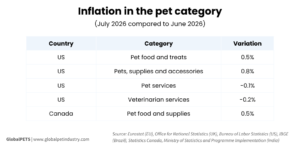
In the US, CPI for pet food and treats rose 0.5% in July, accelerating from June. After remaining unchanged in June, prices for pets, pet supplies and accessories jumped 0.8%.
Veterinary and other services’ CPI decreased by 0.2%, while pet services fell by 0.1%, according to data from the US Bureau of Labor Statistics (BLS).
The general CPI rate returned to marginal growth of 0.1% after a 0.4% decrease in June. This reflected 0.1% increases in both the shelter and food indices. While the index for food away from home increased 0.3%, the energy tracker declined 1.5% in July.
Canada
After declining steadily for most of the first half of the year, the CPI for pet food and supplies rose 0.5% in July.
The overall index rose by the same amount, with a 3% annual increase. “On a YoY basis, higher prices for gasoline and travel tours in July contributed to the acceleration in the headline CPI,” Statistics Canada explained.
Meanwhile, the official statistics institution registered a deceleration in the food purchased from stores index.
Brazil
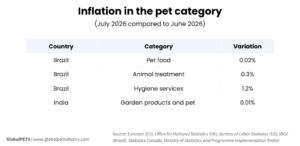
Categories remain volatile in Brazil. While animal treatment fell 0.3% monthly, animal food remained nearly stable with a 0.02% rise and hygiene services grew 1.2%, according to the Brazilian Institute of Geography and Statistics.
The average inflation rate in the country decelerated for the fourth consecutive month, rising by 0.07%. Over the last 12 months, the index stood at 4.44%, finally falling within the Central Bank’s target range of 1.5% to 4.5%.
India
India’s combined CPI index for garden products and pets remained broadly stable, with a marginal 0.01% rise MoM, driven by a 0.14% increase in the urban index and offset by a 0.2% decrease in rural areas, according to the Ministry of Statistics and Programme Implementation.
In 12 months, combined inflation decelerated from 3.8% in June to 2.4% in July for the category, stronger in rural areas (3.9%) than in urban municipalities (3%).
Inflation for all items accelerated, with the general CPI rising 4.4% YoY. The largest index increases were registered in personal care, social protection and miscellaneous goods and services (14.8%), restaurants and accommodation services (7.7%), and food and beverages (5.2%).
Australia
Unlike the countries previously covered, Australia’s data covers the second quarter of 2026 rather than the first quarter, based on data released by the Australian Bureau of Statistics on 29 July.
Prices for pets and related products fell 0.36% in the period, while veterinary and other services rose 0.11%. For all items, seasonally adjusted CPI rose 0.6% in the same period.
Share this story:
One click prioritizes GlobalPETS in your search results and AI answers.